
Manual Therapy
Gentle mobilisation of restricted cervical joints to restore pain-free range.

Specialised care in Allama Iqbal Town, Lahore
Book an assessment Explore your neck ↓Neck pain has become one of the most common complaints we treat, driven largely by screen use, study posture, and stress-related muscle tension.
A targeted physiotherapy programme relieves the pain and corrects the mechanics causing it, so symptoms stop recurring.
Your head weighs about as much as a bowling ball and sits on seven small vertebrae, cushioned by discs and steered by dozens of muscles. Peel back the layers, drag to turn the spine, then slide the posture control to see what a forward head does.
Neutral. The head balances over the shoulders and the small deep muscles at the front do most of the holding.
Spine, discs and muscles: BodyParts3D, © The Database Center for Life Science, CC BY 4.0. The female skull, jaw and teeth were modelled from scratch for this page. A simplified illustration of posture, not a diagnosis. Drag to turn.
Gentle mobilisation of restricted cervical joints to restore pain-free range.
Practical adjustments to your desk, phone, and sleeping position.
Deep neck flexor and scapular work to support the cervical spine.
Heat, TENS, and soft-tissue release to settle acute symptoms.
Each pattern behaves differently. Your assessment finds which one is yours.
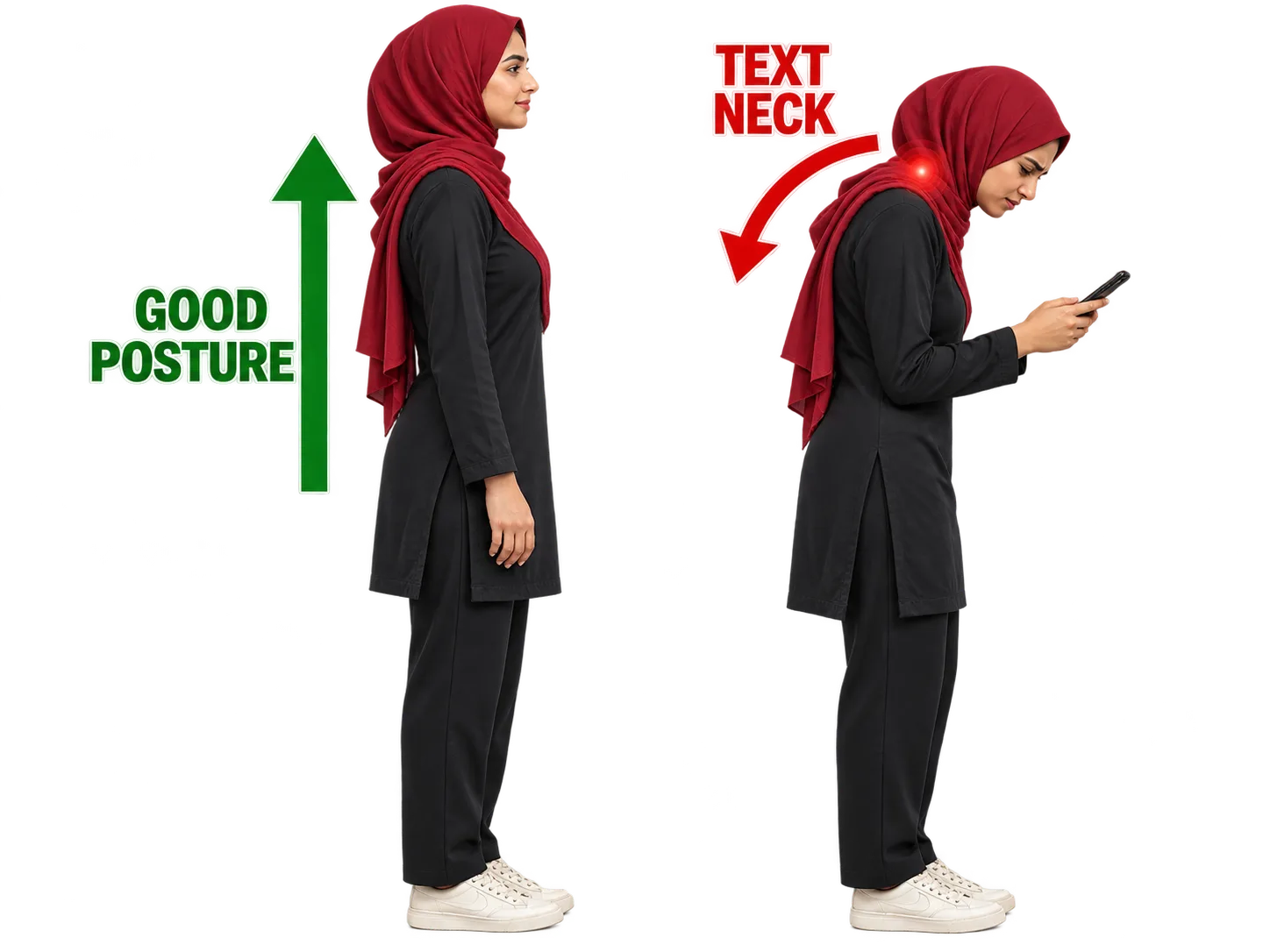
Sustained forward head posture overloading the cervical extensors.
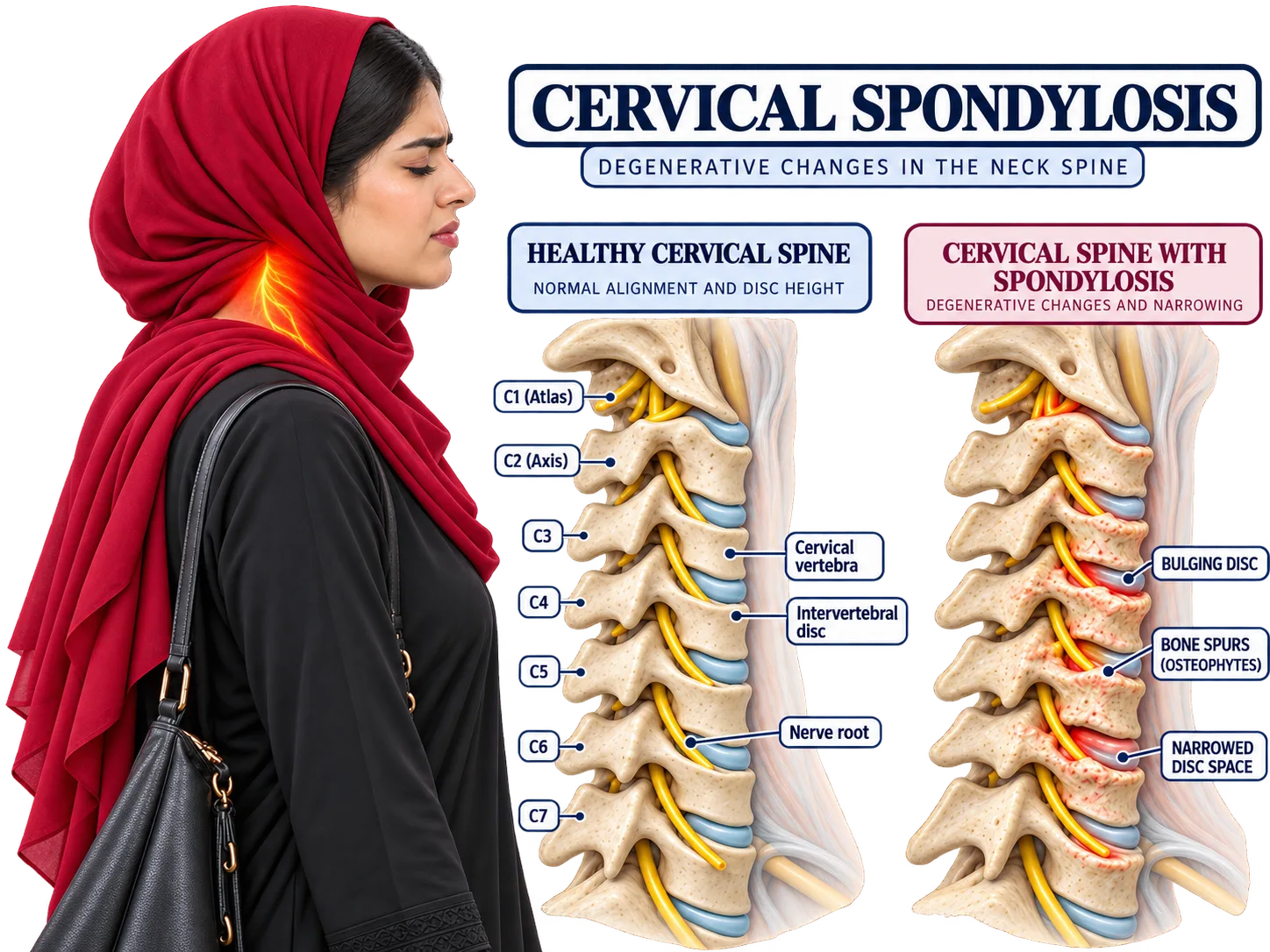
Age-related joint and disc changes causing stiffness and ache.

Headaches originating from upper cervical joint dysfunction.
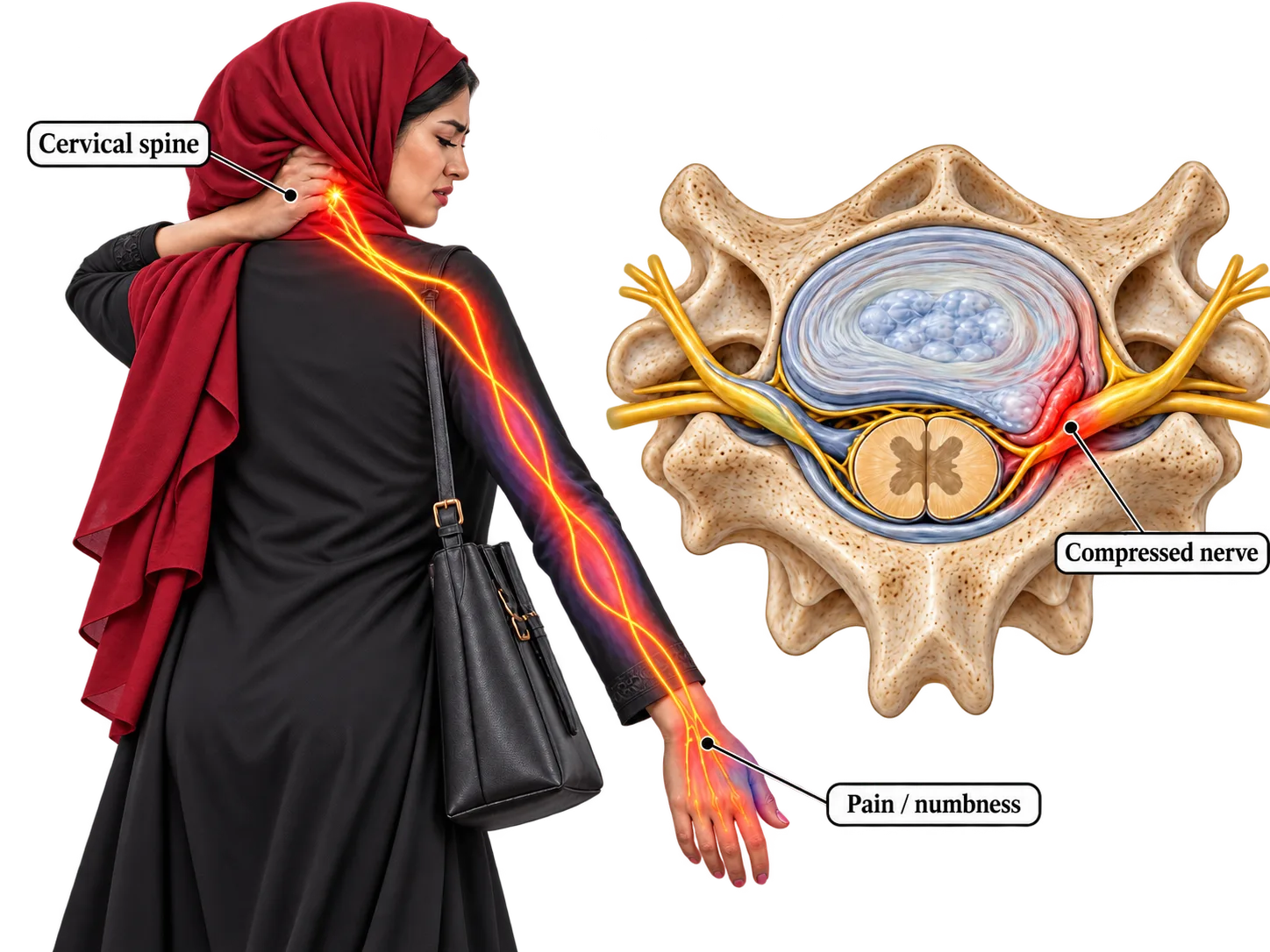
Nerve root irritation producing arm pain, tingling, or weakness.

Post-accident neck strain requiring graded, careful rehabilitation.
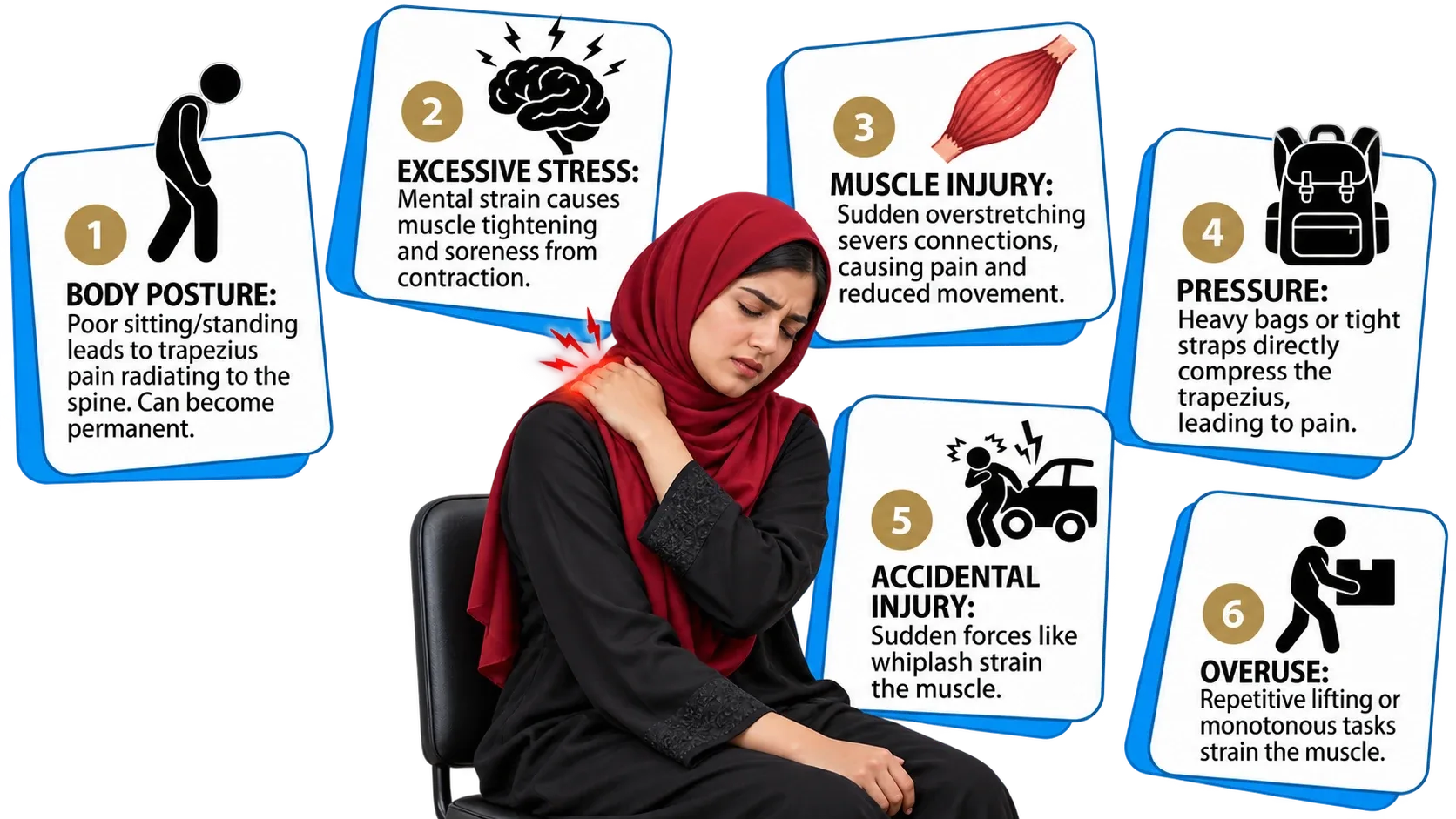
Stress-driven muscle tension across the neck and shoulders.
Most people move through three phases. You move on only when the last one feels comfortable: no pain at rest, and no more than mild discomfort (about 3 out of 10) with the exercises.
Gentle soft-tissue work on the muscles that tighten around the neck: the upper trapezius, levator scapulae, the muscles at the back of the neck and those between the shoulder blades, plus easing a stiff upper back. Pressure should feel helpful, not painful; a minute or two on each area, pausing on tender points.
Slow stretches, then moving the neck through every direction (nodding, tilting and turning), then gentle isometric holds where you press against your own hand without moving. This restores range of movement and starts rebuilding strength safely.
Training the deep muscles at the front of the neck with chin-tuck curls and banded retractions, and the shoulder-blade muscles with rows, shrugs and raises. Stronger, better-coordinated muscles hold the head over the shoulders and lower the chance of the pain returning.
Identify the exact structures producing your symptoms.
Restore joint mobility with hands-on techniques.
Strengthen what is weak, lengthen what is tight.
Change the daily habits driving the problem.
Settle symptoms so you can move and progress.
A maintenance routine that fits your schedule.
Full cervical screening including nerve and posture testing.
A staged plan matched to your symptoms and goals.
Manual therapy plus supervised corrective exercise.
A short daily routine you can actually maintain.
Objective re-testing to confirm improvement.
Long-term prevention and ergonomic follow-up.
Your physiotherapist will help you choose suitable movements and agree repetitions for your assessment. These examples are not an individual prescription.
Build deep neck stability without movement strain.
10 × 5 seconds each directionRetrain the deep neck muscles and bring the head back over the shoulders.
10 × 5 secondsRelease upper trapezius tension.
2 sets of 10Lengthen tight side neck muscles.
3 × 20 seconds each sideStrengthen the postural muscles between the shoulder blades.
3 sets of 10Restore rotation range.
3 × 15 seconds each sideWe assess first and treat second. If something needs a doctor’s opinion, we will tell you and help you get it.
Scans that show “arthritis” or a “bulging disc” are very common and often painless. We look at how your neck responds to movement and load, not only at the picture.
3+ years of clinical experience, with focused expertise in neck pain & cervical spine treatment.
A women-only practice offering culturally sensitive, dignified care, in clinic or at your doorstep.
Patient reviews
My mother had a stroke that left her right arm and leg immobile. With Dr. Munaza’s expert physiotherapy, she regained full movement completely painfree and without any medication. We’re truly grateful for her care and professionalism.
I took home sessions for my neck, shoulder, back, and hip pain. Alhamdulillah, all my pain is gone like a magic. Even my headache, which I had for many years, got better with the exercises. Thank you so much Dr Munaza for your kind treatment and care. May Allah bless you.
“Dr. Munaza treated my neck and shoulder pain, as well as my muscle pull issue, very effectively. With the help of exercises and therapy, I feel much better now. She is very kind, caring, and cooperative. Highly recommended!”
I had neck pain with headaches for a long time. After treatment with Dr. Munaza, my pain got much better and the headaches eased. She listened carefully, treated me gently, and explained everything clearly. I feel relaxed and thankful for her care Best physiotherpist in the area👍🏻
Dr. Munaza is very kind and professional. My shoulder pain improved within a few sessions. Highly recommended!!!!
No referral is needed. You can book directly and we’ll assess you at your first session.
Treatment is gentle and comfort-led. Some techniques cause mild temporary soreness, and we always work within your comfort limits.
It depends on severity and how long you've had symptoms. Most neck pain patients notice improvement within 3–6 sessions; your plan is set after assessment.
Starts from PKR 1,500 for a clinic session. Home visit pricing depends on your location and condition, contact us for a quote.
Yes. Dr. Munaza is a female physiotherapist and the practice is dedicated to women, in a private and culturally sensitive environment.
It varies. Many stiff, achy necks and everyday strains improve over roughly four to six weeks of consistent, graded rehabilitation, while nerve-related arm symptoms often take longer, sometimes two to three months. Your assessment gives you a realistic outlook and we review it as you progress.
Not necessarily. These changes are very common with age and are often painless. What matters is how your neck responds to movement and load, so we treat you, not the scan. We will tell you if your symptoms suggest you need medical tests.
A short rest in a comfortable position is fine, but staying still usually leaves the neck stiffer. Gentle, regular movement within comfortable limits, with no more than mild discomfort, is generally best. We will show you which movements suit you.

 Google review