
Sports Rehabilitation / Shoulder Instability & Rotator Cuff

A shoulder that slips, catches or aches overhead can be rebuilt.

Shoulder instability means the ball of the joint moves too much within, or out of, the socket. Rotator cuff injuries often travel with it, because the cuff is what holds the ball in place. Both are common in cricket bowling, badminton smashes, goalkeeping, volleyball and overhead pressing, and for most people rehabilitation is the first-line treatment, whether or not surgery follows.

The short answer

What is shoulder instability, and how is it treated?

Shoulder instability is a shoulder whose ball moves too far in the socket: fully out (a dislocation), part-way out and back (a subluxation), or loose and untrustworthy in certain positions. It is treated first with rehabilitation: the shoulder blade is retrained, the rotator cuff is strengthened, joint control is rebuilt, and the specific demands of your sport are restored step by step.

Non-surgical rehabilitation typically takes 3 to 6 months, and 6 to 12 months after surgical stabilisation. Rotator cuff injuries are assessed and treated in the same plan, because a cuff that is weak or sore cannot hold a loose shoulder steady.

ForDislocation, subluxation, labral and rotator cuff injuriesWhereAllama Iqbal Town, LahoreSettingPrivate women-only studio

The short version

Shoulder instability rehab, in four numbers.

3–6Months — typical non-surgical rehabilitation timeline.
6–12Months — typical post-surgical rehabilitation timeline.
<25The age group carrying the highest re-dislocation risk, especially in the first two years.
1stLine of treatment for most people — rehabilitation, whether or not surgery follows.

Which one is yours?

Four shoulder problems, each explained in fifteen seconds.

They overlap and they often occur together. Each short animation shows what is happening inside the joint; your assessment works out which of them you actually have.

01 / Instability

Shoulder dislocation

The ball of the upper arm comes right out of the socket, usually out the front, after a fall, a tackle or an awkward reach.

  • Sudden pain and an arm you cannot move
  • The shoulder can look out of shape
  • A doctor puts it back; do not try yourself

Then rehabilitation: typically 3 to 6 months.
02 / Instability

Subluxation

The ball slips part-way out and goes back by itself. No full dislocation is needed for a shoulder to be unstable.

  • A feeling of slipping or looseness
  • A brief “dead arm” after a throw or reach
  • It tends to keep happening

Rehabilitation retrains the muscles that hold the ball in.

03 / Static stabiliser

Labral tear

The labrum is the rim that deepens the socket. It can tear when the shoulder dislocates, which is one reason a shoulder dislocates again.

  • Clicking or catching
  • A deep ache inside the joint
  • Pain or apprehension in overhead positions

Many settle with rehabilitation. Some need a repair.

04 / Dynamic stabiliser

Rotator cuff injury

The cuff is the group of tendons that steadies the ball and lifts the arm. It becomes sore when overloaded, and it can tear.

  • Pain lifting the arm out to the side
  • Worst through the middle of the lift
  • An ache at night lying on that side

Progressive strengthening is the first treatment.

These are simplified teaching drawings, not images of your shoulder. A sudden loss of strength after an injury needs prompt medical review.

Understanding instability

What makes the shoulder unstable in the first place?

The shoulder is the most mobile joint in the body, and that mobility comes at the cost of stability. Stability comes from two systems working together: static stabilisers (the labrum, joint capsule and ligaments) and dynamic stabilisers (the rotator cuff and the muscles of the shoulder blade).

When the static stabilisers are damaged, by a labral tear or ligaments stretched in a dislocation, the dynamic stabilisers have to work harder. If the rotator cuff is not strong enough, well coordinated or trained for the demands of your sport, instability recurs, and the cuff itself becomes overloaded and sore. That is why instability and rotator cuff pain so often arrive together, and why they are treated as one plan.

  1. Static: holds without effort

    The socket (glenoid) is small and shallow next to the ball, like a golf ball on a tee. It covers only part of the ball at any moment, which is why the shoulder can move so far, and why it can slip.

  2. A rim of firm cartilage around the edge of the socket that deepens the cup and acts as a bumper. A dislocation can tear it away, most often at the front and bottom of the socket (a Bankart lesion).

  3. A tough sleeve around the joint, thickened into ligaments that tighten at the end of movement. The lower band is a hammock under the ball when the arm is raised and turned out, the position in which most shoulders dislocate.

  4. Dynamic: muscles you can train

    Four muscles, one in front, one on top and two behind, whose tendons wrap the ball and press it into the socket in every position. Unlike the layers above, the cuff can be strengthened, which is why it sits at the centre of rehabilitation.

  5. The socket sits on the shoulder blade, which turns upward as the arm lifts so the socket stays under the ball. When the muscles that turn it fire late or weakly, the socket is in the wrong place and the cuff has to work harder.

Evidence · Re-dislocation risk

Once it’s dislocated, the risk of it happening again is real.

Once a shoulder has dislocated, the risk of re-dislocation is significant — especially in young athletes. Risk is highest under 25 and within the first two years after the initial injury, though your specific risk also depends on the type of dislocation and any associated injuries.

The sports that provoke it share a pattern: overhead reaching, throwing, or falling onto an outstretched arm. That’s why the sport-specific return phase below matters as much as the strength work that precedes it.

<25Highest re-dislocation risk falls in this age group, in the first two years after injury.

Throwing & bowling

Cricket bowling loads the shoulder in the same vulnerable position repeatedly.

Overhead racquet sports

Badminton smashes demand end-range stability at speed.

Falls & contact

Goalkeeping and field sports risk a fall onto an outstretched arm.

The rehabilitation phases

Scapula first. Cuff second. Sport last.

Each phase has its own criteria for progressing to the next — not a fixed calendar. The shoulder blade comes first for a reason: if it doesn’t move well, nothing built on top of it holds.

01

Acute phase

After a recent dislocation

Communication with your doctor or the emergency department to understand the injury and any imaging, protected range of motion within safe limits, pain and inflammation management, and early rotator cuff/scapular activation in safe positions — avoiding extreme external rotation combined with abduction.

02

Scapular rehabilitation

Scapular muscle activation — serratus anterior, lower trapezius, rhomboids — movement-pattern retraining, postural correction, and thoracic spine mobility, since a stiff upper back forces the shoulder to compensate.

03

Rotator cuff strengthening

Isometric exercise in safe positions first, then isotonic exercise progressing through range, with emphasis on external rotation — often the weakest direction and the most important for instability — integrated with scapular control throughout.

04

Proprioception & neuromuscular control

Joint position sense exercises, perturbation training, and closed-chain work — rebuilding the brain’s map of where the shoulder is in space, which is impaired after a dislocation and contributes directly to re-injury.

05

Progressive strengthening

A gradual increase in resistance and complexity through functional movement patterns — pushing, pulling, lifting, carrying — with overhead progressions introduced only when ready, under strict form criteria.

06

Sport-specific return

Critical, and often neglected. The shoulder must be prepared for the specific demands of your sport — see the return progressions below.

Sport-specific return

The demands of your sport, rebuilt on purpose.

This is where most rehabilitation programmes stop too early — and where re-injury actually happens. Each sport gets its own progression, not a generic "shoulder programme."

Throwing sports (cricket)

A progressive throwing programme from flat-ground to a full run-up, increasing distance and intensity in controlled steps.

Racquet sports (badminton)

A progressive hitting programme building toward full overhead smash intensity.

Swimming

Stroke-specific progressive loading, matched to your event and stroke mechanics.

Gym / weightlifting

Progressive overhead pressing and stabilisation work, rebuilt from the ground up.

Goalkeeping / field sports

Falling and landing drills, and contact preparation for the demands of the position.

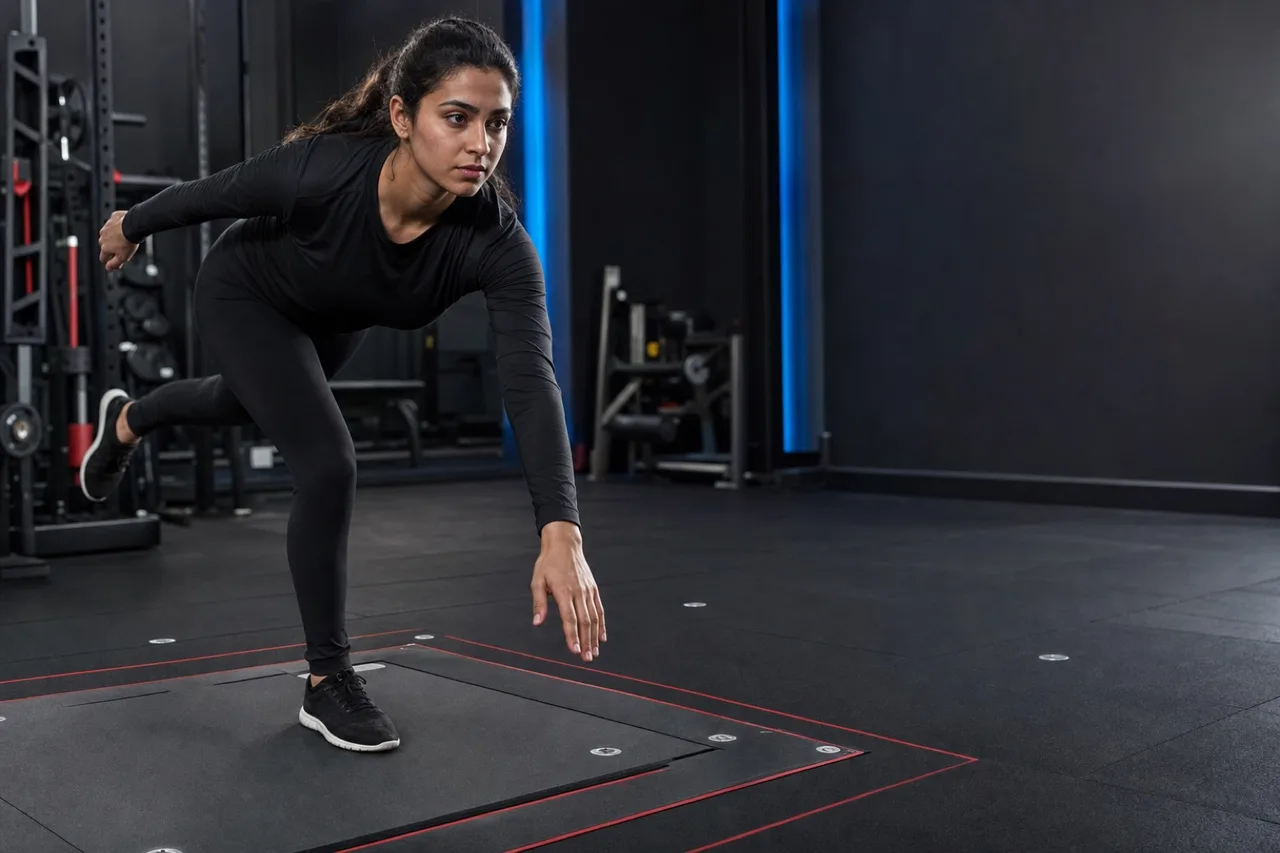
South Asian female athlete performing a controlled single-leg return-to-sport test in a professional gym

Ready, not just pain-free

We test the shoulder before your sport does.

Pain settling is not the same as a shoulder that is ready. A bowler needs to tolerate repeated high-speed throws; a goalkeeper needs to land on an outstretched arm; a lifter needs control under load overhead. Before each step back toward your sport, we check that the shoulder meets the demands of that step, and we compare it with your other side.

01

Range of motion Full, comfortable movement, including the positions your sport uses.

02

Rotator cuff strength Rotation strength compared with the other shoulder, with external rotation watched most closely.

03

Shoulder-blade control The shoulder blade keeps moving well as you tire, not only on the first repetition.

04

Weight through the arm Stability and confidence taking load on the hands, as in a push-up position or a fall.

05

Sport drills Throwing, hitting, pressing or diving rebuilt to full speed without symptoms.

06

Confidence No apprehension in the position that used to feel vulnerable.

Tests are chosen for your injury, your sport and your stage. Passing them reduces risk; it cannot remove it.

When more is needed

When surgery may be part of the plan.

Surgery — typically arthroscopic labral repair or a stabilisation procedure — may be recommended if you’ve had multiple dislocations despite adequate rehabilitation, if you have a significant labral tear that hasn’t responded to conservative management, or if your sport demands a level of stability that rehabilitation alone can’t provide.

If surgery is needed, we provide pre-operative rehabilitation to optimise your muscle function beforehand, post-operative rehabilitation following your surgeon’s protocol, and the same phased, sport-specific return described below.

Multiple dislocations

Despite a real course of adequate rehabilitation.

A significant labral tear

That hasn’t responded to conservative management.

High-stability sports

Where rehabilitation alone can’t provide what your sport demands.

Who is involved

One plan, each professional in their lane.

Shoulder rehabilitation works best when the people involved communicate and stay within their scope.

01

Sports physiotherapist

Assessment, the rehabilitation plan, exercise progression, testing and the staged return to sport.

02

Shoulder surgeon or sports physician

Diagnosis, imaging decisions, and the surgical opinion when a shoulder keeps dislocating or a tear needs repair.

03

Coach or trainer

Training load and technique, adjusted to each stage, once we have agreed what the shoulder is ready for.

With your consent

We share findings and progress with your surgeon or coach only with your written consent.

Your first appointment

What to expect, whether this is recent or recurring.

If your dislocation is recent: we start by understanding the injury and any imaging findings your doctor or the emergency department already has, assess your current range and pain, and begin safe, protected movement and early rotator cuff and scapular activation the same day.

If this isn’t your first dislocation, or you’re further out from the injury: we do a full reassessment across scapular control, rotator cuff strength, proprioception and the movement patterns your specific sport demands, and build your programme from where you actually are.

If surgery is being considered or already booked: with your written consent, we coordinate directly with your shoulder surgeon, both before and after the operation.

Recent dislocation

Injury and imaging review, pain management, safe protected movement started the same day.

Recurrent instability

A full reassessment across scapular, cuff, proprioceptive and sport-specific factors.

Considering surgery

We coordinate directly with your shoulder surgeon, before and after.

Frequently asked

Straight answers.

I dislocated my shoulder once. Will it happen again?

The risk of re-dislocation is highest in young athletes (under 25) and in the first two years after the initial injury. Good rehabilitation significantly reduces this risk, but does not eliminate it entirely. Your own risk depends on your age, sport, the type of dislocation and any associated injuries.

My shoulder feels unstable but I have never had a full dislocation. Is that possible?

Yes. This is called subluxation: the ball slips part-way out of the socket and goes back by itself. It can be just as troublesome as a full dislocation, and it is absolutely appropriate for physiotherapy assessment and management.

Is my pain from the rotator cuff or from instability?

Often both. The rotator cuff is the main muscle group that holds the ball in the socket, so a loose shoulder makes it work harder, and an overworked cuff becomes sore. Pain through the middle of a lift and at night points toward the cuff; slipping, a “dead arm” or fear of certain positions points toward instability. The assessment tells them apart.

Can a rotator cuff injury get better without surgery?

Most rotator cuff-related shoulder pain is treated with a progressive strengthening programme first, and many people do well with that alone. A sudden loss of strength after a fall or injury is different and needs prompt medical review, because some tears are best repaired early. We will tell you if yours needs a doctor’s opinion.

Do I need an MRI before I start?

Not usually. Most shoulder problems can be assessed and started on rehabilitation without a scan. If you have had a dislocation, an X-ray will normally already have been taken. If your examination suggests a significant tear or another injury, we refer you to a doctor for imaging.

Should I avoid overhead movements permanently?

No. That is the goal of rehabilitation. You should be able to return to overhead movements with proper strength, control and confidence. In the early phases we avoid vulnerable positions, but progressive exposure under controlled conditions is part of the process.

How long until I can return to my sport?

For non-surgical rehabilitation: typically 3 to 6 months, depending on the sport and your progress. For post-surgical rehabilitation: typically 6 to 12 months. Throwing and overhead sports generally take longer than non-overhead sports.

I have had three dislocations. Is rehab still worth trying?

Yes, though surgery is more likely to be recommended at this point. Even if you choose surgery, pre-operative rehabilitation improves your outcome. We will assess your current status and discuss the options honestly, including referral to a shoulder surgeon if needed.

Can I keep training while I rehabilitate?

Usually, in a modified form. Lower-body and trunk training normally continue, and upper-body work is adjusted to stay out of the positions and loads that provoke the shoulder. Stopping everything is rarely the answer.

Your next move

Book a shoulder instability assessment.

Tell us what happened, what sport you play, and what you want to get back to. We’ll tell you honestly how we can help.