
Running progression
Straight-line running first, then curves, then sprinting and rapid changes of direction.
Sports Rehabilitation / Ankle Sprain
Ankle sprains are one of the most common sports injuries — and one of the most under-rehabilitated. Up to 70% of people who sprain their ankle develop chronic problems, and up to 40% re-sprain within the first year. The number one predictor of an ankle sprain? A previous ankle sprain.
The short answer
An ankle sprain is a stretch or tear of the ligaments that hold the ankle, most often on the outside when the foot rolls inward with the toes pointed. Sprains are graded 1 (stretched), 2 (partly torn) or 3 (completely torn), and almost all recover without surgery.
Treatment starts on day one: protect the ankle as much as it needs, walk and move within comfort, and begin balance work early. Strength, balance and sport-specific drills then rebuild the ankle in stages, because an ankle that is only rested often stays weak, unsteady and likely to sprain again.
The short version
Understanding sprains
Ankle sprains are classified by severity. Grade 1 (mild): the ligament is stretched but not torn — mild swelling and pain, no significant instability, recovery in 1–2 weeks with proper rehab. Grade 2 (moderate): a partial tear, moderate swelling and pain, some instability, recovery in 3–6 weeks. Grade 3 (severe): a complete tear, significant swelling, pain and instability, recovery in 6–12 weeks or longer if other structures are involved.
The most commonly injured ligament is the anterior talofibular ligament (ATFL), on the outside of the ankle, injured when the foot rolls inward. But the injury is more than the ligament — it also damages proprioceptive receptors, joint capsule tissue, surrounding muscles and tendons, and the brain’s "map" of the ankle. If you only wait for the pain to go away, you’re vulnerable to re-injury.
Most sprains happen when the foot rolls inward with the toes pointed. The first ligament to stretch or tear is the anterior talofibular ligament, which runs forward from the outer ankle bone. It is the most commonly injured ligament in sport.
In a bigger roll, the next ligament down, from the outer ankle bone to the heel bone (the calcaneofibular ligament), is injured too. The more ligaments involved, the higher the grade and the longer the recovery.
When the foot is forced to turn outward, the ligament that binds the two shin bones together just above the joint can be injured instead. It hurts higher up and at the front, and usually takes longer to recover, so it needs to be picked up at the first assessment.
Two muscles on the outside of the lower leg, whose tendons pass behind the outer ankle bone, react to stop the foot rolling. After a sprain they are slower and weaker, so retraining their strength and reaction time is central to rehabilitation.
Ligaments and joints carry sensors that tell the brain where the foot is. A sprain disturbs those signals, which is a big part of why an ankle feels unsteady and sprains again. Balance training restores them and lowers the risk of another sprain.
The first 24–72 hours
POLICE is an evolution of the old RICE advice: Protect the ankle as needed, Optimal loading — gentle, pain-guided movement, not complete rest — Ice for pain and swelling, Compression, and Elevation.
Gentle range-of-motion exercises (ankle pumps, alphabet tracing) start immediately, and weight-bearing as tolerated is supported by the evidence — early movement, not prolonged rest, is what protects the ankle’s long-term function.
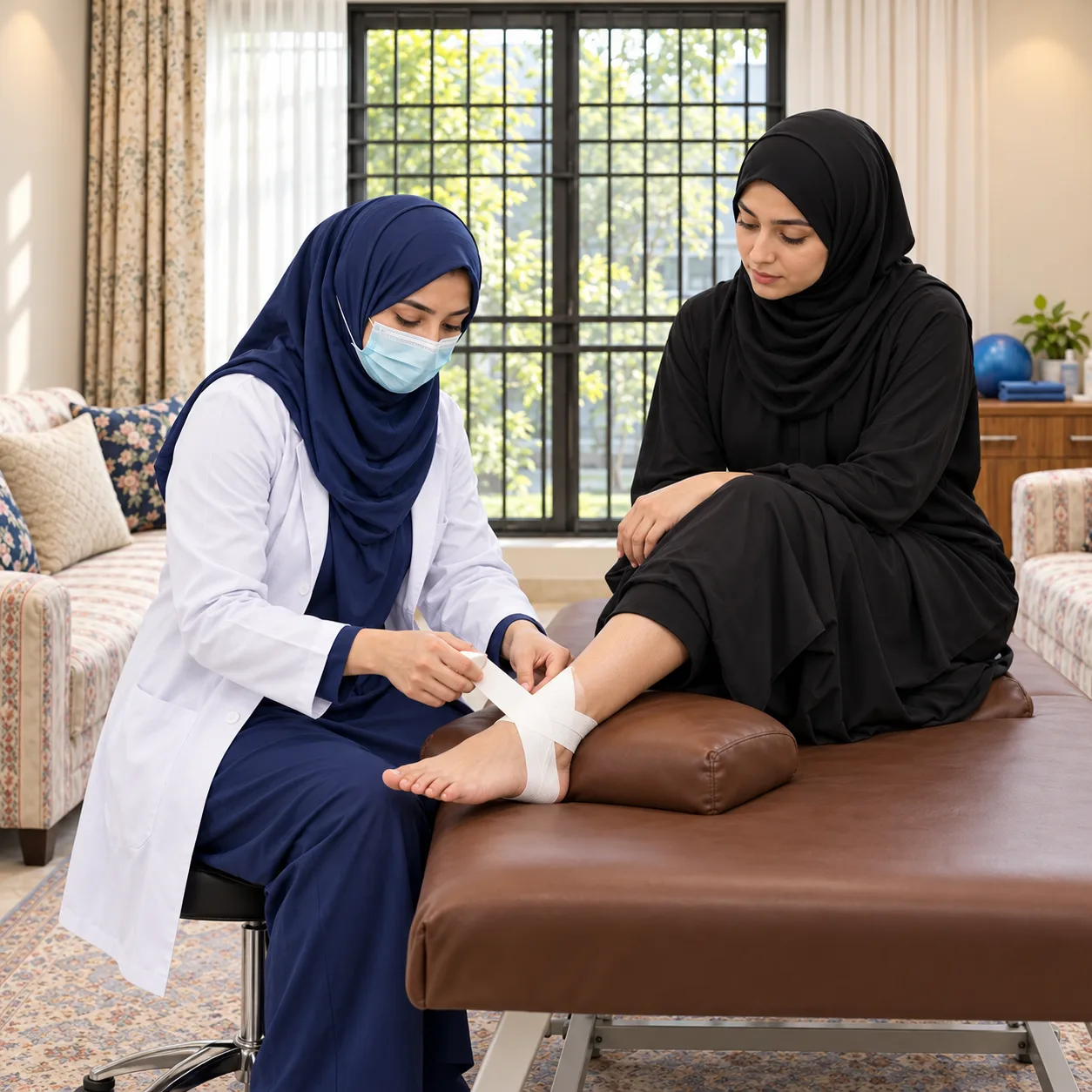
Support the ankle as needed — not immobilise it indefinitely.
Gentle, pain-guided movement from day one.
For pain and swelling management alongside movement, not instead of it.
The rehabilitation phases
Proprioception starts immediately, not once the pain has settled — it’s the single most important component of a sprain that doesn’t become a chronic problem.
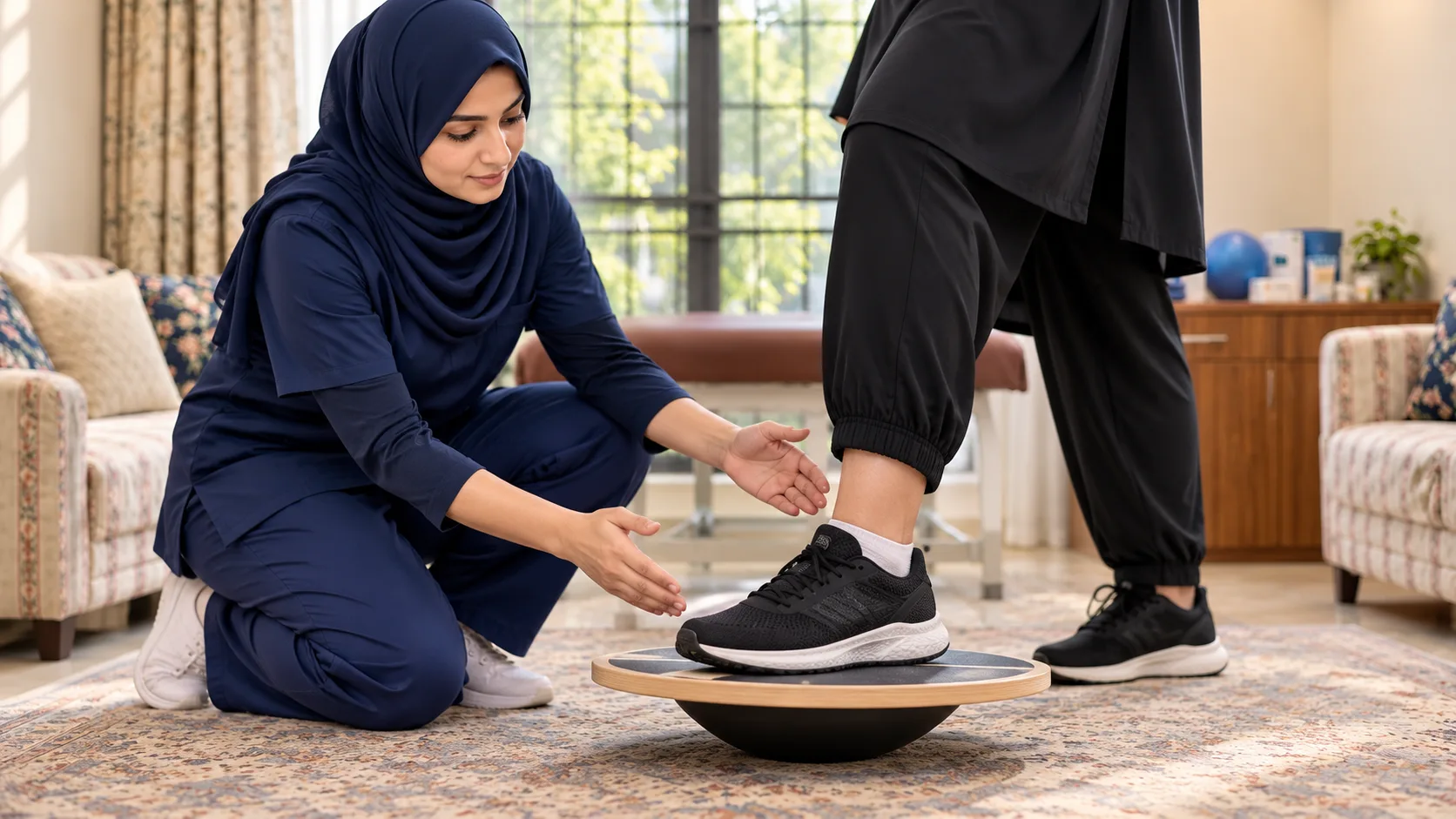
Range-of-motion restoration, gentle isometric-to-band strengthening, and proprioception work beginning immediately — single-leg balance, eyes-closed balance, progressing to unstable surfaces — plus manual therapy for joint and soft tissue stiffness.
Calf raises, resisted inversion/eversion, tibialis anterior strengthening, and hip strengthening — often overlooked, though weak hips contribute directly to poor ankle control — through single-leg squats, deadlifts and step-ups.
Balance progression from stable to unstable to dynamic to sport-specific, perturbation training, and agility ladder and cone drills — progressing in speed and complexity as control returns.
Running progression from straight-line to curves to sprinting, cutting and pivoting drills, jumping and landing training with an emphasis on alignment, and a considered decision on taping or bracing for return to sport.
When it keeps happening
If you’ve had multiple sprains and your ankle feels unreliable, ligament laxity can be a factor — but it’s often not the only one, or even the main one. Poor proprioception, weakness, compensatory movement patterns and inadequate rehabilitation are frequently the bigger contributors, and many people with genuinely lax ankles can be highly stable with good rehabilitation.
For chronic instability, we do a comprehensive assessment of every contributing factor — ligament laxity, proprioception, strength, movement patterns and foot mechanics — with a more intensive proprioception and neuromuscular control programme, and a strength programme addressing the entire kinetic chain from foot to hip. If conservative management fails, we coordinate with an orthopaedic surgeon to discuss surgical stabilisation options.
Ligament laxity, proprioception, strength, movement patterns and foot mechanics — all of it, not just the ankle.
A more advanced neuromuscular control programme than a first-time sprain needs.
Foot, ankle, knee and hip — weak links anywhere in the chain compromise ankle control.
Sport-specific return
Return-to-sport is based on passing specific milestones — not a fixed number of weeks since injury. These are the areas we test before clearing you.

Straight-line running first, then curves, then sprinting and rapid changes of direction.
Sport-specific change-of-direction drills with a controlled, confident landing.
Alignment checked specifically — the knee tracking over the toe, not collapsing inward.
Ladder and cone drills progressed in speed and complexity as control returns.
Whether external support makes sense for your return to sport, and for how long.
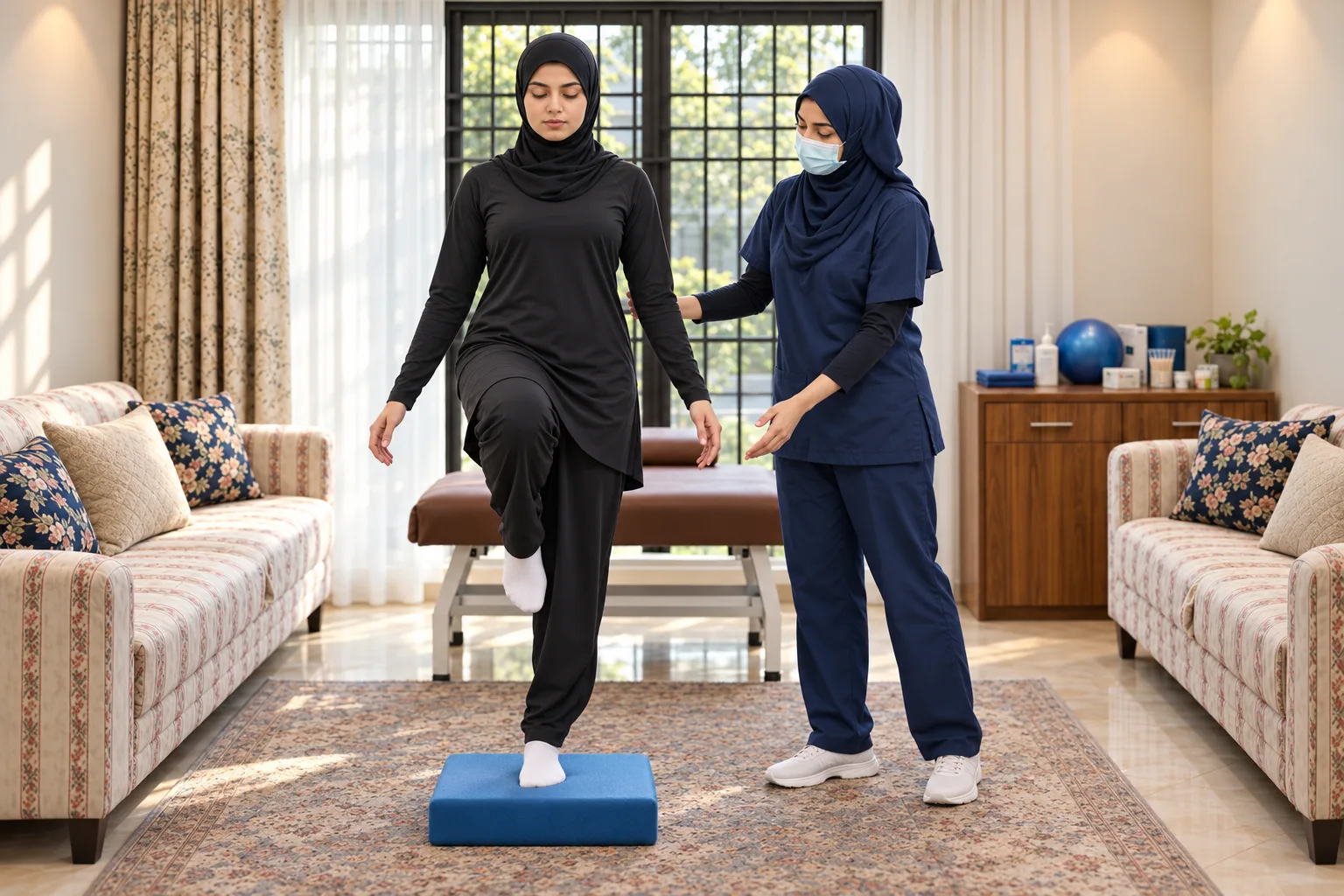
Ready, not just pain-free
Swelling going down is not the same as an ankle that is ready to cut, jump and land. Before each step back toward your sport, we check that the ankle meets the demands of that step, and we compare it with the other side.
Walking and running No limp walking, then easy running without pain or swelling afterwards.
Single-leg balance Balance with eyes open and closed, compared with the other ankle.
Calf and ankle strength Single-leg heel raises and strength rolling the foot outward, side to side.
Hop tests Forward and sideways hops landed softly and with control.
Change of direction Cutting and pivoting at match speed without hesitation.
Confidence No feeling of the ankle giving way on uneven ground or in contact.
Tests are chosen for your injury, your sport and your stage. Passing them lowers the risk of another sprain; it cannot remove it.
Your first appointment
If you can’t weight-bear at all, if there’s bony tenderness at specific points, or the mechanism was high-energy, an X-ray to rule out fracture is worth getting first — typically at the emergency department or via your doctor. If you’ve already been cleared of a fracture, we can begin rehabilitation immediately.
If this is your first sprain: we assess severity, begin the POLICE protocol and proprioception work the same day, and give you a clear plan for each phase ahead.
If you keep spraining the same ankle: we do a full reassessment of everything that contributes to chronic instability — not just the ligament — and build a programme addressing the whole kinetic chain.
Severity assessment, POLICE protocol, and proprioception work started the same day.
A full reassessment across ligament, proprioception, strength and movement factors.
We’ll flag if an X-ray is warranted first — and pick up rehab as soon as you’re cleared.
Frequently asked
If you can’t weight-bear at all, if there’s bony tenderness at specific points, or if the mechanism was high-energy, an X-ray rules out fracture — typically done at the emergency department or by your doctor. If you’ve already been cleared of fracture, we can begin rehabilitation immediately.
Some residual swelling with activity can persist for several weeks to months, especially after a moderate or severe sprain. If swelling is significant, painful, or not gradually improving, it warrants assessment to check for other issues.
No. Braces provide external stability while you rebuild internal stability — proprioception, strength, neuromuscular control. The goal is gradually reducing dependence on external support as your ankle’s own stability improves.
Ligament laxity can be a factor, but it’s often not the only one — or even the main one. Poor proprioception, weakness, compensatory movement patterns and inadequate rehabilitation are frequently the bigger contributors, and many people with "loose" ankles can be highly stable with good rehabilitation.
For a mild sprain with good rehab: 2–3 weeks. Moderate: 4–6 weeks. Severe: 8–12 weeks. These are general timelines — your actual return depends on your specific injury, your progress through rehab milestones, and the demands of your sport. Return-to-sport is based on passing tests, not calendar dates.
Usually yes, as comfort allows, often with tape or a brace at first. If you could not take four steps straight after the injury, or specific points of the ankle bones are tender to press, get an X-ray first to rule out a fracture.
Protection, a little ice and raising the leg can ease pain and swelling in the first days, but long rest is no longer advised. Moving and walking within comfort, with early balance work, leads to a better recovery. A severe sprain may need a short time in a boot or brace first; we will tell you what yours needs.
An injury to the ligament that binds the two shin bones together just above the ankle, usually from the foot being forced to turn outward. It hurts higher up than a common sprain and takes longer to recover, so it is checked for at the first assessment.
Yes. Munaza Physio Studio in Allama Iqbal Town, Lahore, is a private, women-only studio with female physiotherapists, so squats, hops, running drills and every part of the assessment can be done comfortably in modest clothing.
Your next move
Tell us what happened, how many times it’s happened before, and what you want to get back to. We’ll tell you honestly how we can help.