Walk-jog intervals
Starting well below your usual volume, not jumping back to your normal run.
Sports Rehabilitation / Patellofemoral Pain
Patellofemoral pain — often called "runner’s knee" — is pain around or behind the kneecap. It’s one of the most common knee complaints in runners and active people, and it’s usually not a structural damage problem: the cartilage isn’t typically worn away. It’s a load-management and movement-quality problem — which is good news, because movement patterns and muscle function can be changed.
The short answer
Patellofemoral pain, often called runner’s knee, is pain around or behind the kneecap brought on by loading the bent knee: squatting, stairs, running, hills, jumping, or sitting for a long time with the knees bent. It is one of the most common causes of knee pain in active women and teenagers, and it is usually a problem of load and movement rather than damage to the joint.
Treatment is exercise therapy: hip and knee strengthening done consistently for at least six weeks, with training load brought down and then built back in stages. Taping can ease pain while you train. Most people improve without injections or surgery, and a scan is rarely needed.
The short version
Understanding patellofemoral pain
The patella sits in a groove on the femur (the trochlear groove) and acts as a pulley for the quadriceps muscle. For it to track smoothly through that groove, the forces pulling on it from different directions need to be balanced. When they’re not, the patella presses harder against one side of the groove — and that’s where the pain comes from.
Two things sit inside the knee: the kneecap’s groove, and the load that rises as the knee bends. Three things are yours to change: the strength of the quadriceps, the control of the hip, and how quickly training load goes up. Rehabilitation works on all three.
The kneecap (patella) glides up and down a groove at the front of the thigh bone every time the knee bends, over the thickest cartilage in the body. Patellofemoral pain comes from this joint and the tissues around it, usually without damage that a scan would show.
The deeper the knee bends under body weight, the harder the kneecap presses into its groove. That is why squats, stairs (going down most of all), hills, jumping and long sitting with bent knees provoke it, and why the pain follows how much and how often the knee is loaded.
The thigh muscle pulls the kneecap through its groove and absorbs force with every step. When it is weak, the joint takes more of that force. Quadriceps strengthening is one of the best-supported treatments for patellofemoral pain.
When the hip muscles do not hold the thigh, it turns inward and the knee drifts in over the foot as you land, squat or step down, changing how the kneecap meets its groove. Strengthening the hip as well as the knee works better than knee exercises alone.
A sudden jump in running distance, hills, stairs, jumping or a new class is the most common trigger. The answer is not to stop everything: load comes down to what the knee tolerates, then builds back step by step as strength improves.
What actually throws off tracking
Weak hip muscles — particularly gluteus medius and maximus — let the femur rotate inward during weight-bearing, which changes the angle the quadriceps pulls the patella at. Tight lateral structures (the iliotibial band, the lateral retinaculum) can pull the patella outward, while dynamic knee valgus — the knee collapsing inward during squats, landing or running — loads the joint asymmetrically.
The vastus medialis obliquus (VMO), the inner quad muscle that helps pull the patella medially, is often blamed for being "weak" — but the research points more consistently to a timing problem: the VMO firing later relative to the vastus lateralis, not simply firing with less force. That’s a retrainable movement pattern, not a muscle you can just make bigger.
The Q-angle — the angle between the hip, kneecap and shin — gets cited constantly, but the evidence is genuinely mixed: some studies find it elevated in patellofemoral pain, others find no difference at all. It’s one piece of a multifactorial picture, not a diagnosis on its own. Training load errors (too much, too soon) and foot or ankle mechanics that affect knee alignment from the ground up round out the real contributors.
When gluteus medius and maximus do not hold the thigh, the far side of the pelvis drops, the thigh turns in and the knee drifts inward over the foot in squats, landings and running. That changes the angle at which the quadriceps pulls the kneecap through its groove.
The inner quadriceps (vastus medialis obliquus) helps steer the kneecap toward the middle of its groove. In patellofemoral pain it often switches on later than the outer quadriceps, so the kneecap is pulled outward first. Timing can be retrained.
A tight iliotibial band and outer retinaculum pull the kneecap outward and tilt it, so it presses harder on the outer side of its groove.
The angle between the pull of the thigh muscle and the line of the kneecap tendon is often blamed, but the evidence is mixed. It is one piece of the picture, not a diagnosis on its own.
When the arch flattens on landing, the shin turns inward and the knee follows, adding to the inward drift from the hip. Foot and ankle control, and for some people foot orthoses, can help.
The assessment
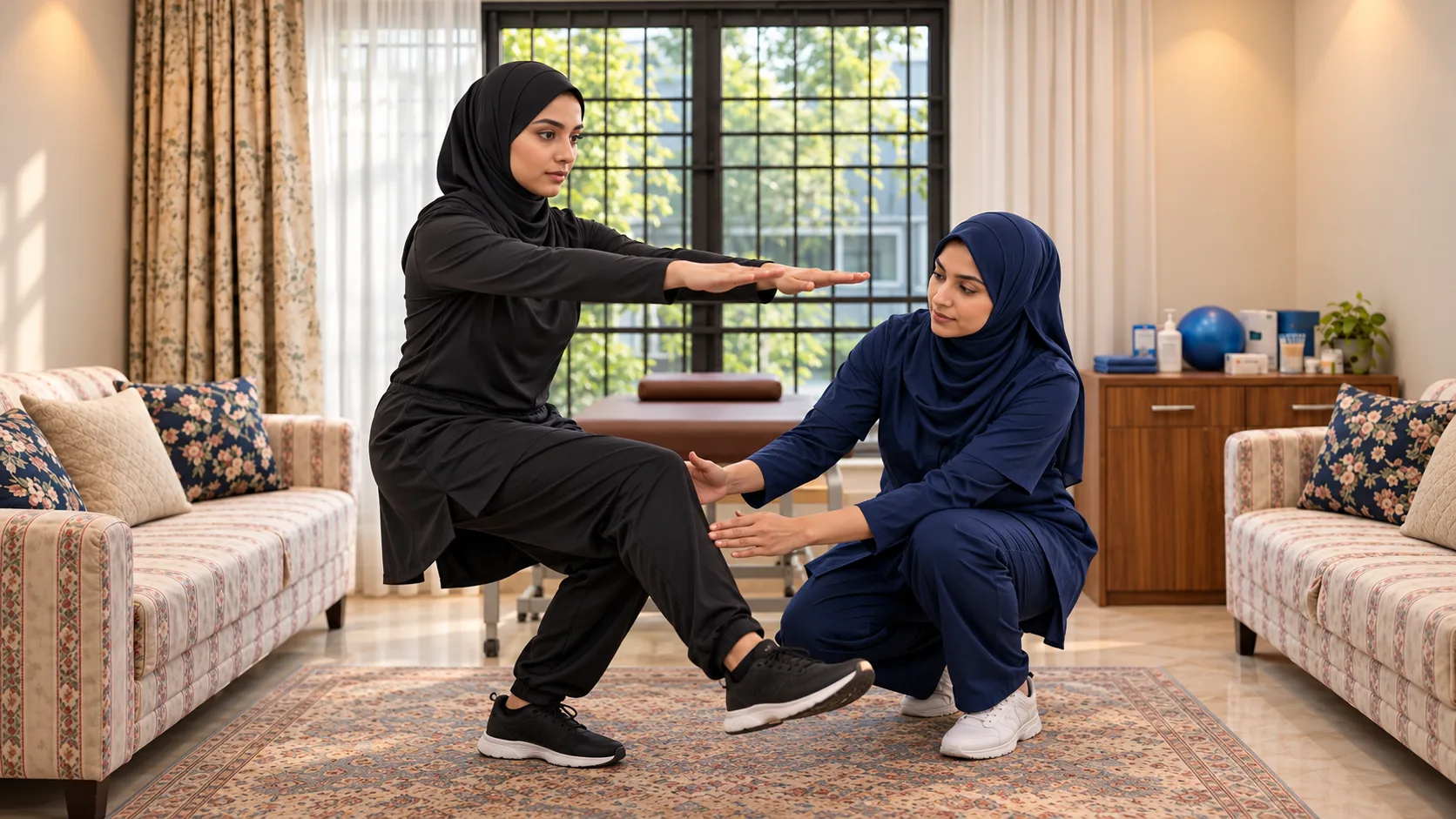
Foot and ankle mobility and how your foot strikes the ground; the knee itself — patellar tracking, range of motion, tender points including Hoffa’s fat pad, the pad of fat just below the kneecap that can become irritated and contribute to anterior knee pain in its own right; hip strength and control during single-leg tasks; pelvis and trunk position during movement; and a real movement analysis — squats, single-leg squats, step-downs, and running if that’s relevant to you.
Specific tests carry real diagnostic weight here: pain reproduced by squatting is present in roughly 9 out of 10 people with patellofemoral pain, and a positive patellar tilt test is one of the more reliable findings on examination. We also review your training load — what you’ve actually been doing, how much, and how it’s changed — since that’s often the missing piece.
Mobility, arch control, and how your foot strikes the ground.
Strength and control during single-leg tasks, squats and step-downs.
What you’ve been doing, how much, and how it’s changed recently.
The rehabilitation approach
The evidence doesn’t support one single "best" exercise — individualised programming targeting hip, trunk and knee, done consistently, is what actually moves the needle.
Soft-tissue work for tight lateral structures — the IT band, lateral retinaculum, tensor fasciae latae — joint mobilisation for the patellofemoral and tibiofemoral joints, careful management of Hoffa’s fat pad irritation when present, and hip or lumbar spine work where contributing factors exist there.
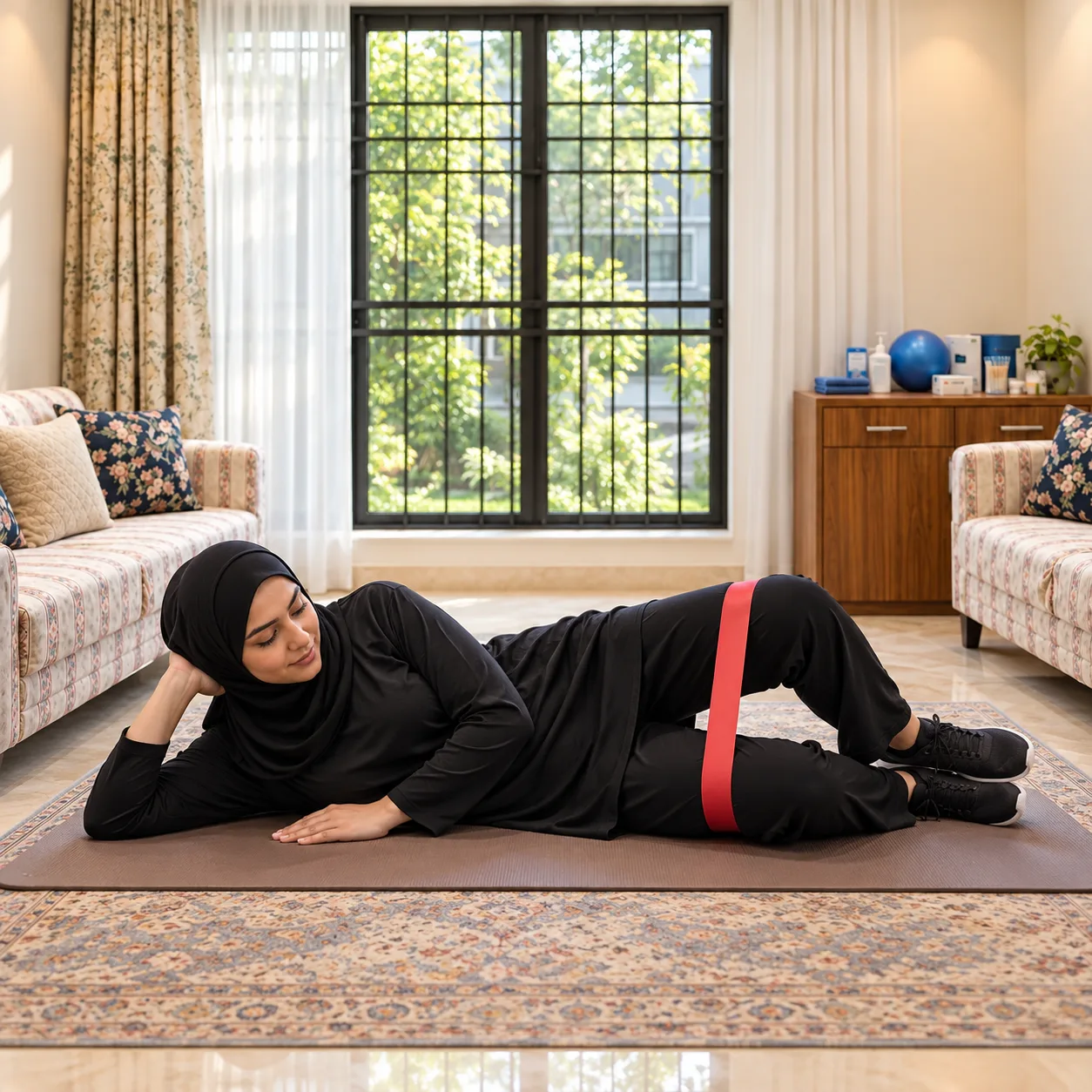
Hip strengthening is often the primary intervention — gluteus medius work (clamshells, standing abduction, single-leg exercises) and gluteus maximus work (bridges, hip thrusts, step-ups) — alongside full quadriceps strengthening in functional positions, progressed with whatever equipment you have access to.
Squat mechanics — knee tracking over the toes, trunk position — landing mechanics, and step-down control targeting femoral internal rotation. Patellar taping can give immediate pain relief, which lets you train with less pain and confirms the pain is mechanically driven; we teach you to apply it yourself.
Graded return to running
Complete rest is rarely the answer — it reduces your tissue capacity, which makes the problem worse when you return. This is how we actually progress you back.
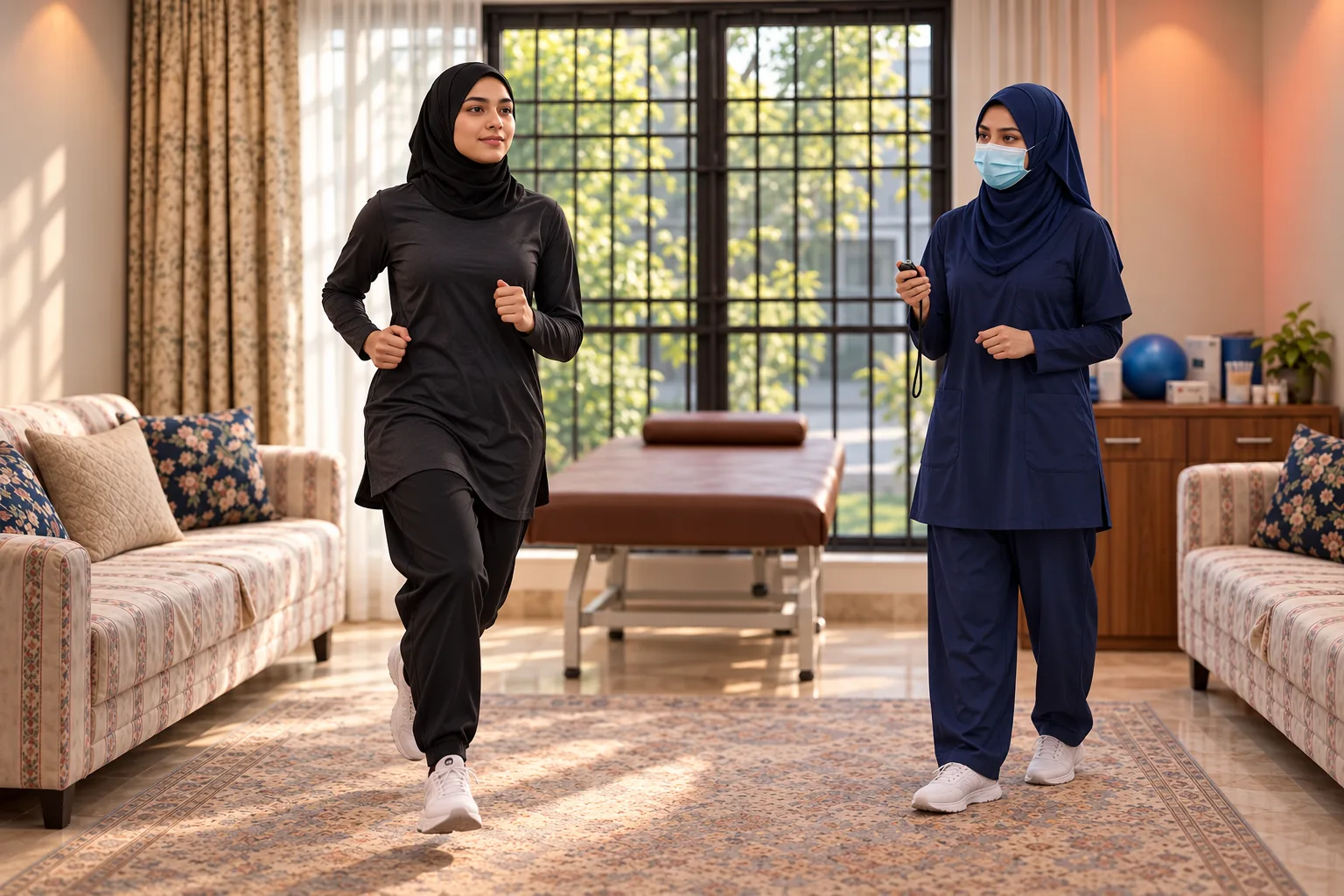
Starting well below your usual volume, not jumping back to your normal run.
Progression based on pain both during the run and 24–48 hours after it — not just how it felt at the time.
Increasing step rate, where appropriate, can meaningfully reduce load on the knee.
Flat ground first, then hills, then uneven terrain.
Only introduced once volume is well tolerated — the last variable to change, not the first.
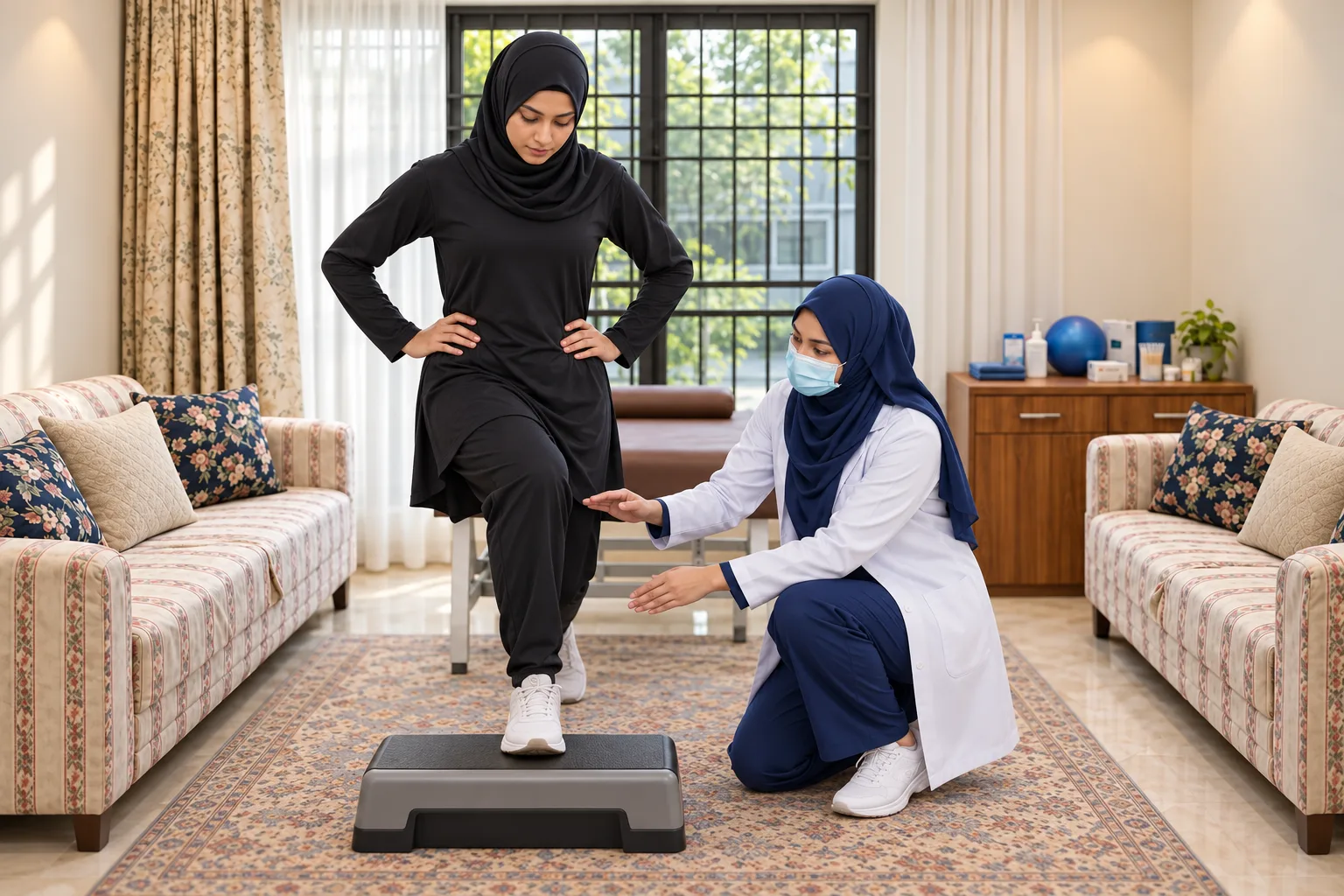
Ready, not just pain-free
A knee that is quiet at rest is not yet a knee that is ready for running, jumping or a full class. Before each step back, we check that the knee and hip can take that step’s load, and we compare the two sides.
Pain response No rise in pain during the next stage’s loads, or the morning after them.
Single-leg squat The knee stays over the foot and the pelvis level, on the painful side as well as the other.
Step-down A slow, controlled step down from stair height without the knee caving in or pain.
Strength Quadriceps and hip strength compared with the other leg.
Hop and land Single-leg hops landed softly and with control, for running and jumping sports.
Running Planned runs completed at the intended distance and pace without a flare.
Tests are chosen for your sport and stage. Passing them lowers the chance of a flare; it cannot remove it.
Your first appointment
If you’ve been told your cartilage is "worn" and nothing can be done — that’s not the full picture. Many people have worn-looking cartilage on scans with no pain at all, and many people with patellofemoral pain have completely normal-appearing cartilage. The pain relates far more to load and movement patterns than to what a scan shows. We don’t let a scan result decide your rehab before a real assessment does.
We’ll assess your whole movement chain in your first session, identify the actual contributing factors for you specifically — not a generic list — and give you a plan that starts that day, including whether running needs modifying (not necessarily stopping) while we address the underlying factors.
Cartilage appearance on imaging correlates poorly with patellofemoral pain.
Foot, hip, movement pattern and training load — the same first visit.
Including whether and how to modify running, not just "stop."
Frequently asked
Surgery is very rarely indicated. The vast majority of cases improve significantly with appropriate rehabilitation and load management. It may be considered in exceptional cases with a clear structural abnormality and extensive conservative management that has genuinely failed — but that’s uncommon.
No. Many people have "worn" cartilage on scans but no pain, and many people with patellofemoral pain have normal-appearing cartilage. The pain relates more to load and movement patterns than cartilage status. Don’t let a scan result discourage you from rehabilitation.
Not necessarily. We may need to modify your running — reduce volume, change surface, adjust cadence — while we address the underlying factors. Complete rest is rarely the answer, since it reduces your tissue capacity and can make the problem worse when you return.
Yes. Chronic patellofemoral pain is more challenging than acute cases, but it still responds to appropriate rehabilitation. It may take longer and need additional factors addressed, but improvement is genuinely possible.
For patellofemoral pain, taping is generally more effective than bracing because it directly addresses patellar tracking. Braces can offer some proprioceptive input and psychological confidence, but they don’t correct the underlying movement pattern — we use taping as a tool within the broader programme.
Most people notice a clear difference within 6 to 12 weeks of consistent exercise therapy. Pain that has lasted years can take longer and may flare when load changes; we set milestones so you can see progress rather than guess at it.
Sitting with the knees bent keeps the kneecap pressed into its groove for a long time, which a sensitive knee notices. It is a classic sign of patellofemoral pain. Straightening the leg every so often helps while the knee settles.
No. Patellofemoral pain is a load-related pain of the kneecap joint, common in teenagers and young adults whose X-rays are normal. Having it does not mean the knee is wearing out, and the same strengthening and load management help either way.
Yes. Munaza Physio Studio in Allama Iqbal Town, Lahore, is a private, women-only studio with female physiotherapists, so squats, hops, running drills and every part of the assessment can be done comfortably in modest clothing.
Your next move
Tell us where the pain is, what makes it worse, and what you want to get back to. We’ll tell you honestly how we can help.