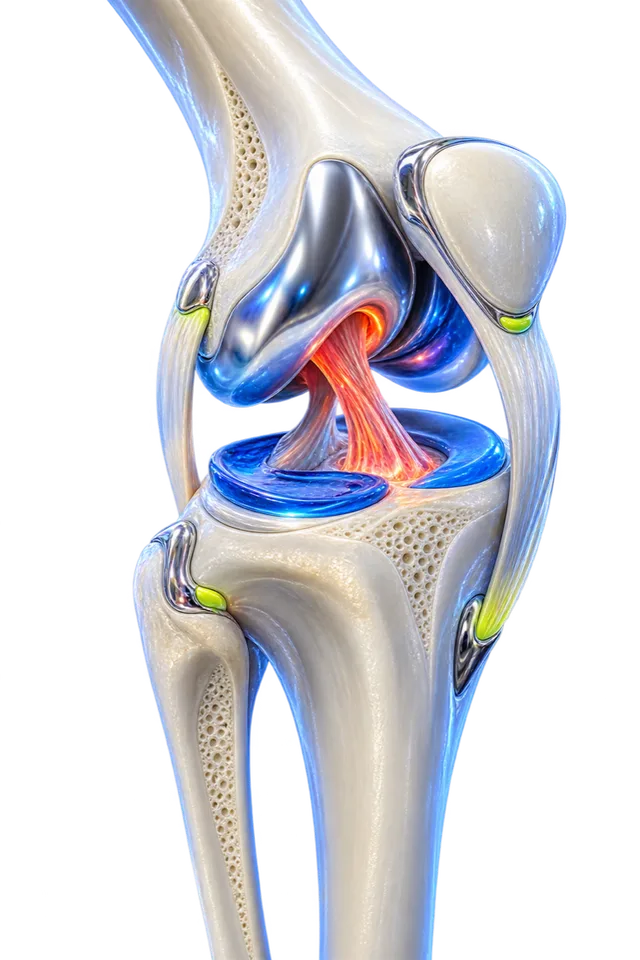
Female Anatomical Planes & Axes Explained: A Visual Guide for Physiotherapy
· 20 min read · Munaza Ghani
Munaza Physio Studio
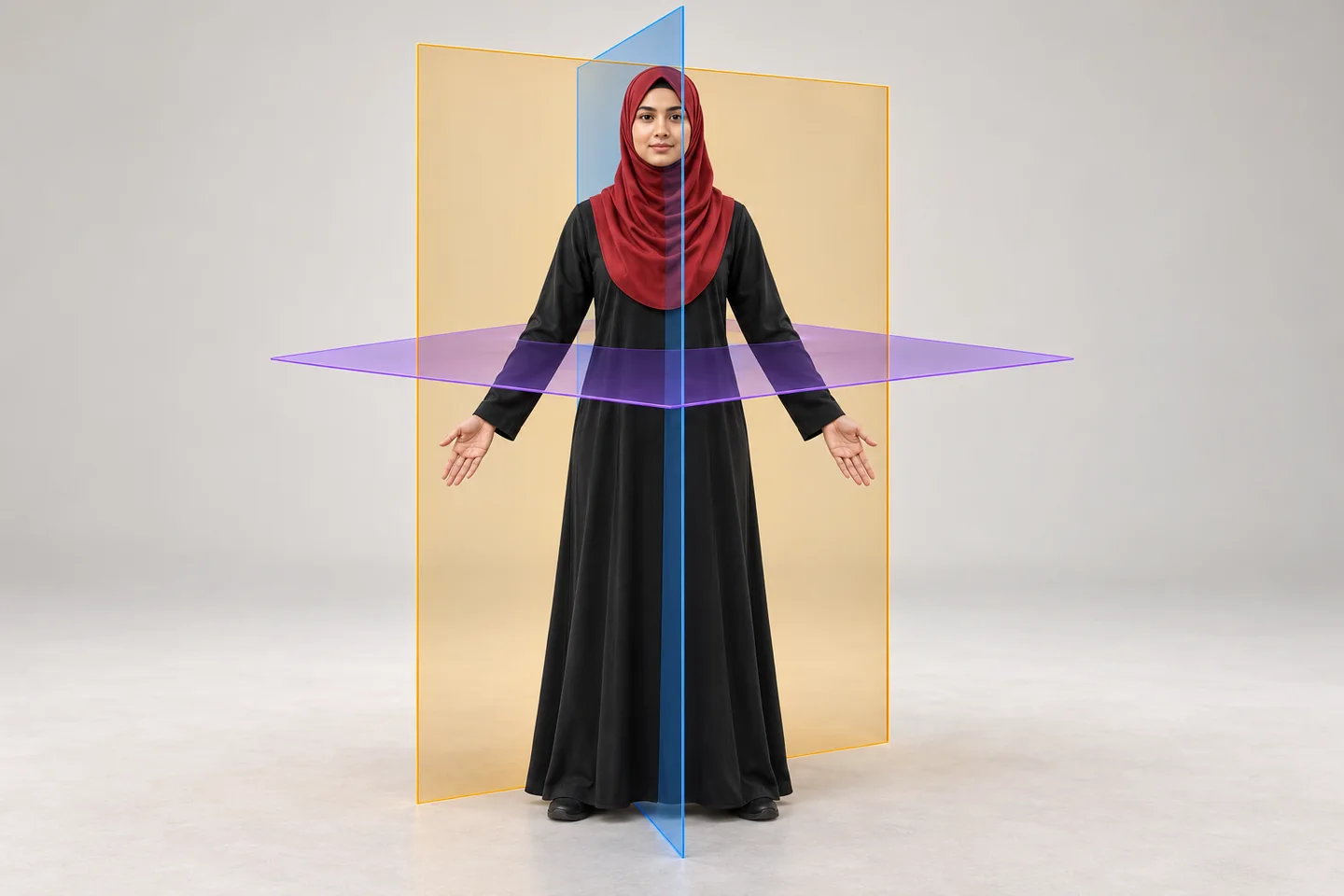
Anatomical planes are imaginary flat surfaces that divide the body, and axes are imaginary lines through a joint around which a bone rotates. The three cardinal planes are sagittal, frontal and transverse. In a simplified single-plane model, each plane has one perpendicular axis: mediolateral, anteroposterior or longitudinal. Together they give clinicians a shared language for describing movement.
This article is educational. The planes, axes and bodies shown here are simplified, and nothing on this page is personal treatment advice.
What you will learn
- Describe the anatomical position and use directional terms correctly.
- Explain the difference between a plane and an axis.
- Name the three cardinal planes, what each divides and the movements that typically occur in it.
- Match each plane with its perpendicular axis, including alternative names.
- Apply the ideas to the shoulder, hip, knee, elbow, forearm, ankle, foot and trunk.
- Identify the plane and axis of a movement you observe, and know the limits of that simplification.
Anatomical position and direction
Anatomical position is the standard reference for describing the body. The person stands upright, facing forward, with the feet together or slightly apart, the arms by the sides and the palms facing forward. Everything is described as if the body were in that position, which means descriptions stay consistent whoever is looking and however the person is actually standing or moving. Real movement does not have to start from anatomical position; the position is a map reference, not a rule.
Planes and axes apply equally to every body. The figure used in this article is a neutral, schematic adult female model, and it is a simplification, not a measurement of any individual.
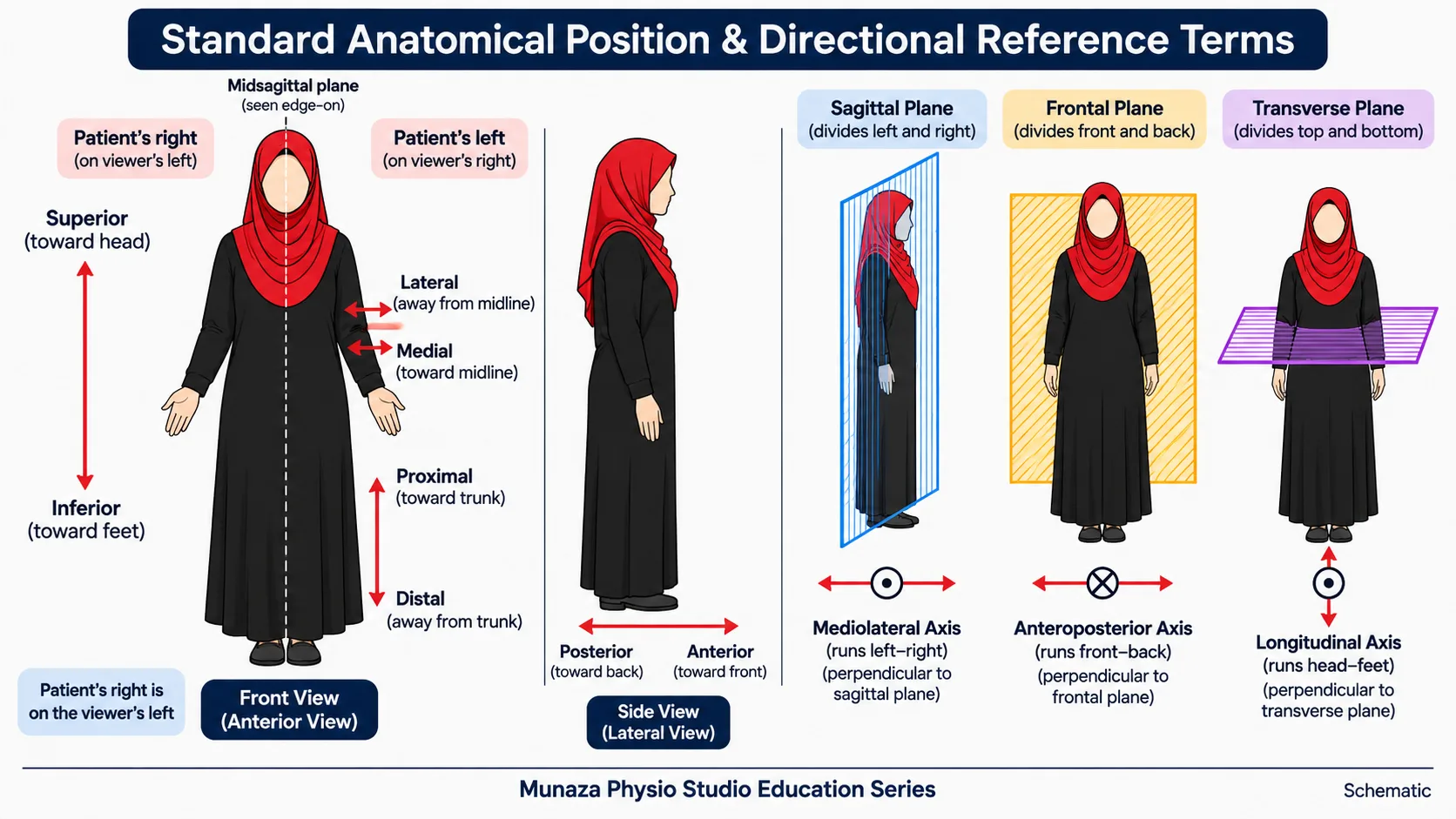
Learn these direction words first, because plane and axis descriptions depend on them:
- Superior and inferior: towards the head and towards the feet.
- Anterior and posterior: towards the front and towards the back.
- Medial and lateral: towards the midline and away from it.
- Proximal and distal: nearer to or further from the trunk, used for limbs.
- Left and right always mean the patient's left and right, not the observer's.
Plane versus axis
A plane is an imaginary two-dimensional surface. It is used to describe where a movement happens, in the way a flat sheet might slice through the body.
An axis is an imaginary line. It is used to describe what a movement rotates around, in the way a door turns about its hinge.
In a simplified model where a bone swings within one plane, the axis of rotation is perpendicular to that plane. A door swings across the floor, a flat surface, around a vertical hinge, which is a line at right angles to it. Joints work in the same way: the movement sweeps through a plane, and the pivot line passes through the joint at right angles to it.
The sagittal plane
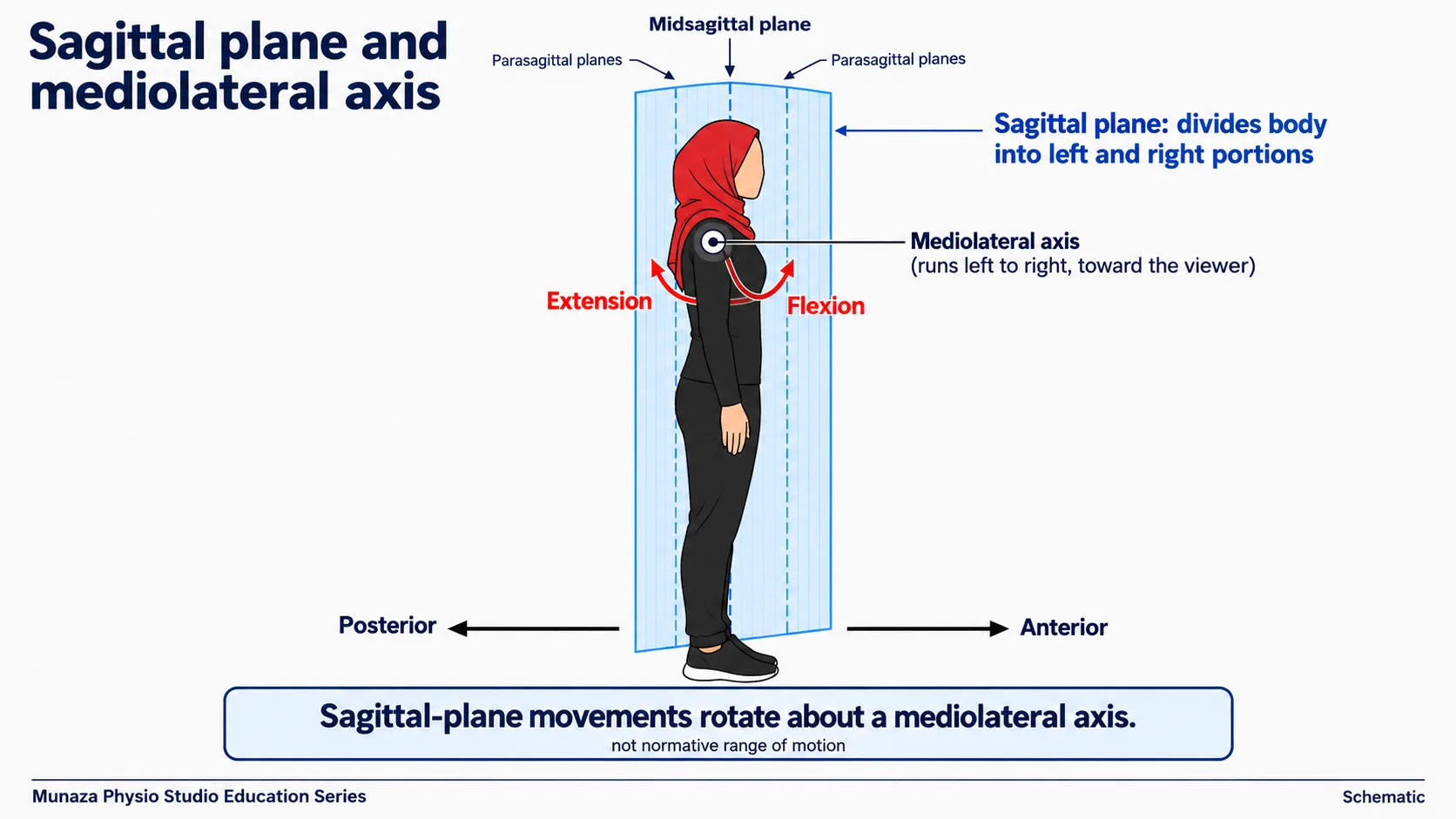
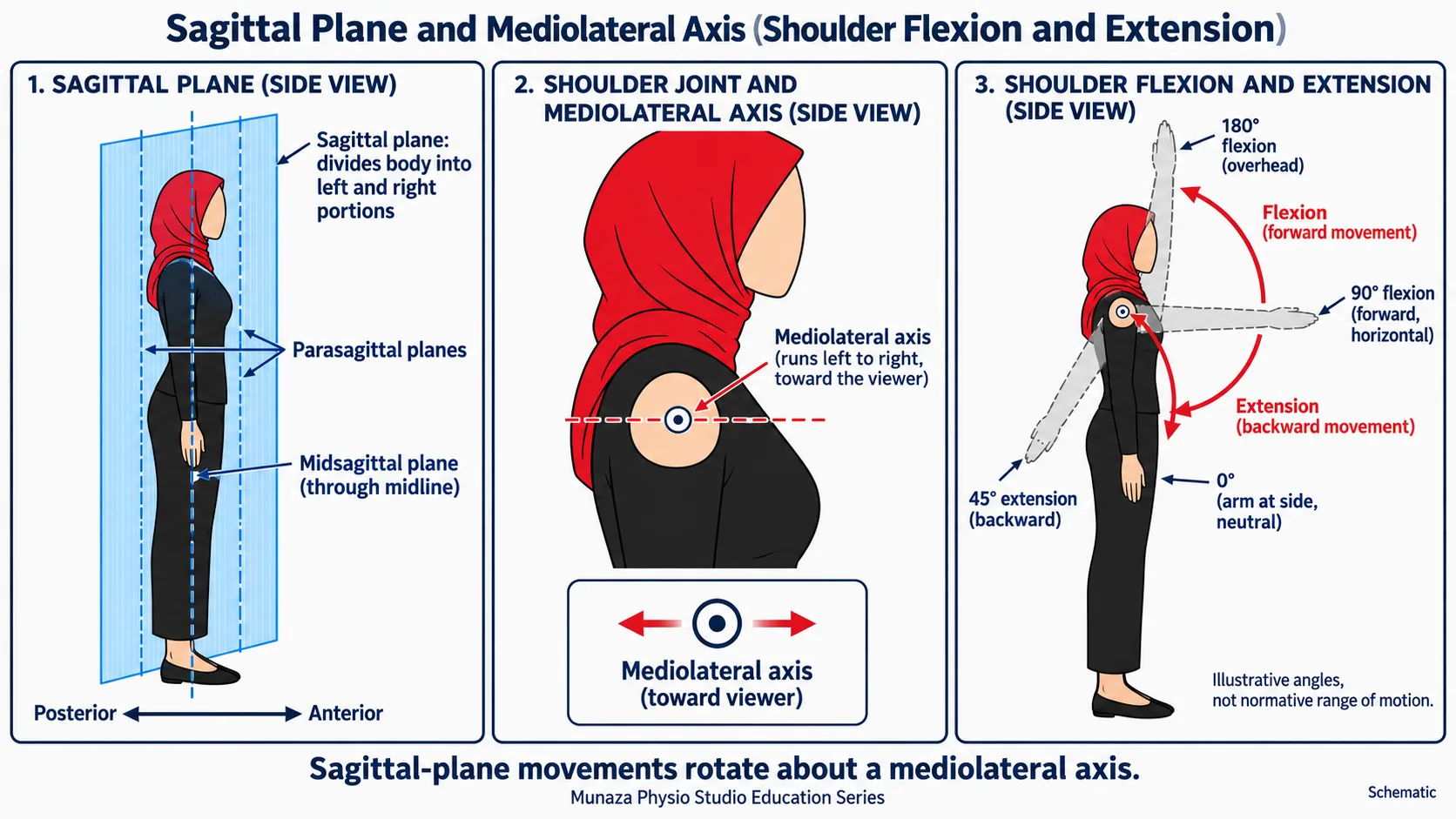
The sagittal plane runs from front to back and divides the body into left and right portions. Many planes can be sagittal, because any vertical plane parallel to this direction counts. Two terms matter:
- The midsagittal (or median) plane passes through the middle of the body. It is the only sagittal plane that divides the body into equal left and right halves.
- Parasagittal planes lie parallel to the midsagittal plane, to either side of it.
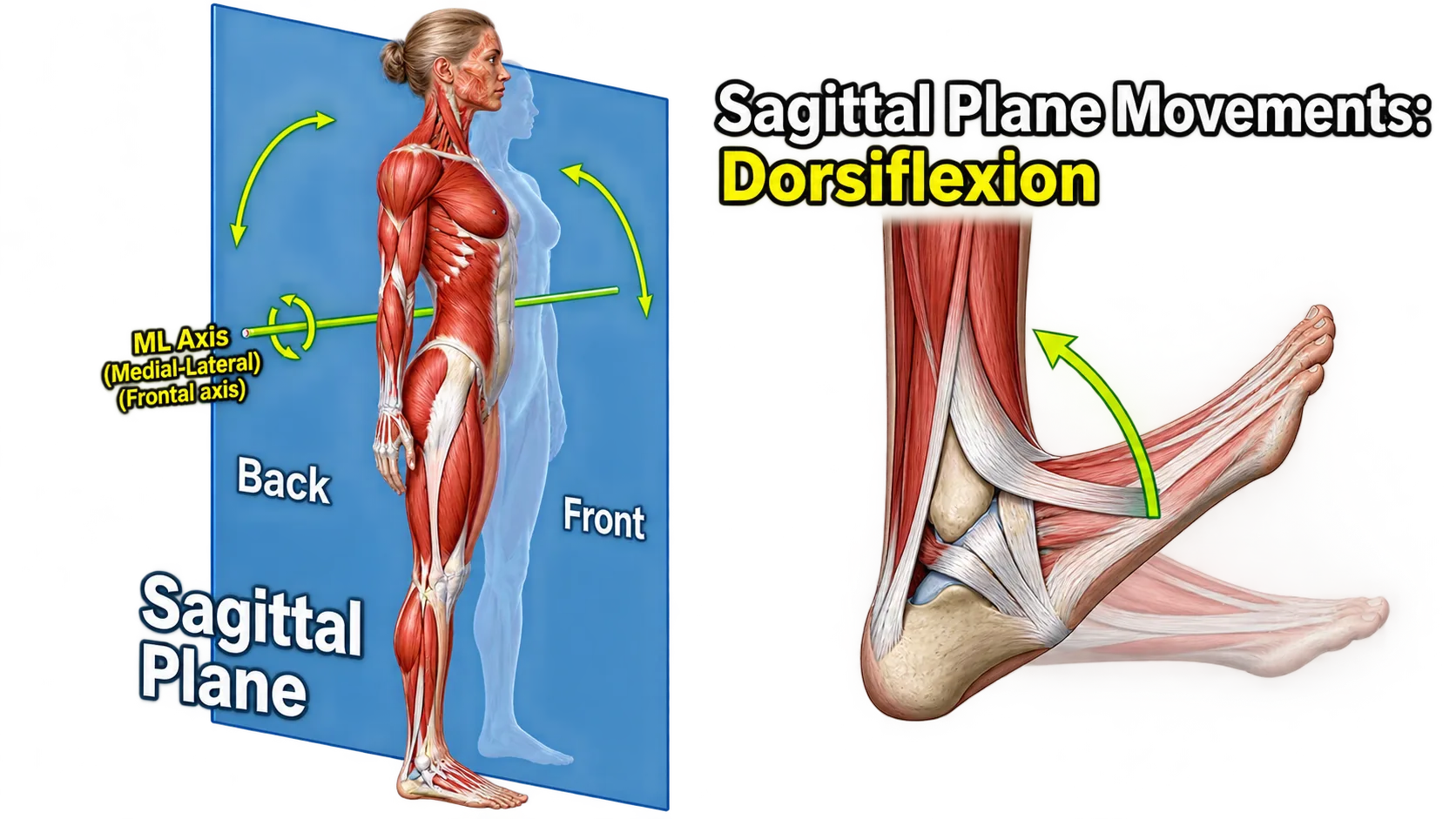
Movements in the sagittal plane are forward and backward movements. The typical examples are flexion and extension: bending and straightening the elbow, flexing the spine forward, flexing the hip or the shoulder, and dorsiflexion and plantarflexion of the ankle.
The perpendicular axis is the mediolateral axis, running from side to side. You will also see it called the frontal axis or the transverse axis, which is a common source of confusion because those names are used for other things too. The mediolateral name describes exactly where the line runs, so this article uses it.
The frontal plane
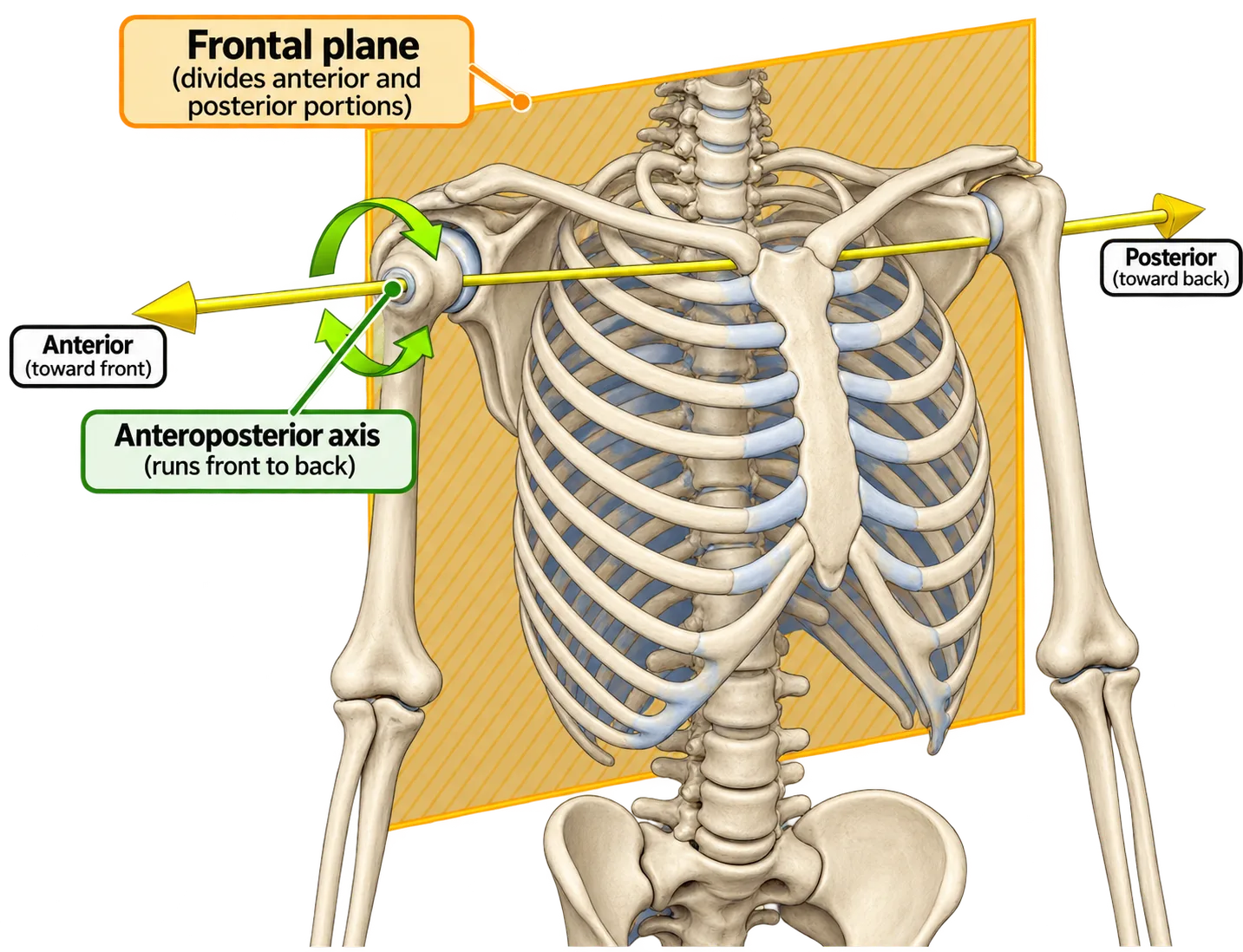
The frontal plane, also called the coronal plane, runs from side to side and divides the body into anterior and posterior portions, front and back. Frontal and coronal are two names for the same plane. Like sagittal planes, frontal planes do not have to divide the body into equal parts; a frontal plane can pass through the body at any depth.
Movements in the frontal plane are side-to-side movements. Typical examples are:
- abduction and adduction of the shoulder and hip, which move the limb away from and back towards the midline;
- lateral flexion of the spine, bending the trunk or neck sideways;
- radial and ulnar deviation of the wrist;
- elevation and depression of the shoulder girdle.
The perpendicular axis is the anteroposterior axis, running from front to back. It is sometimes called the sagittal axis, because it lies in the direction of the sagittal plane.
The transverse plane
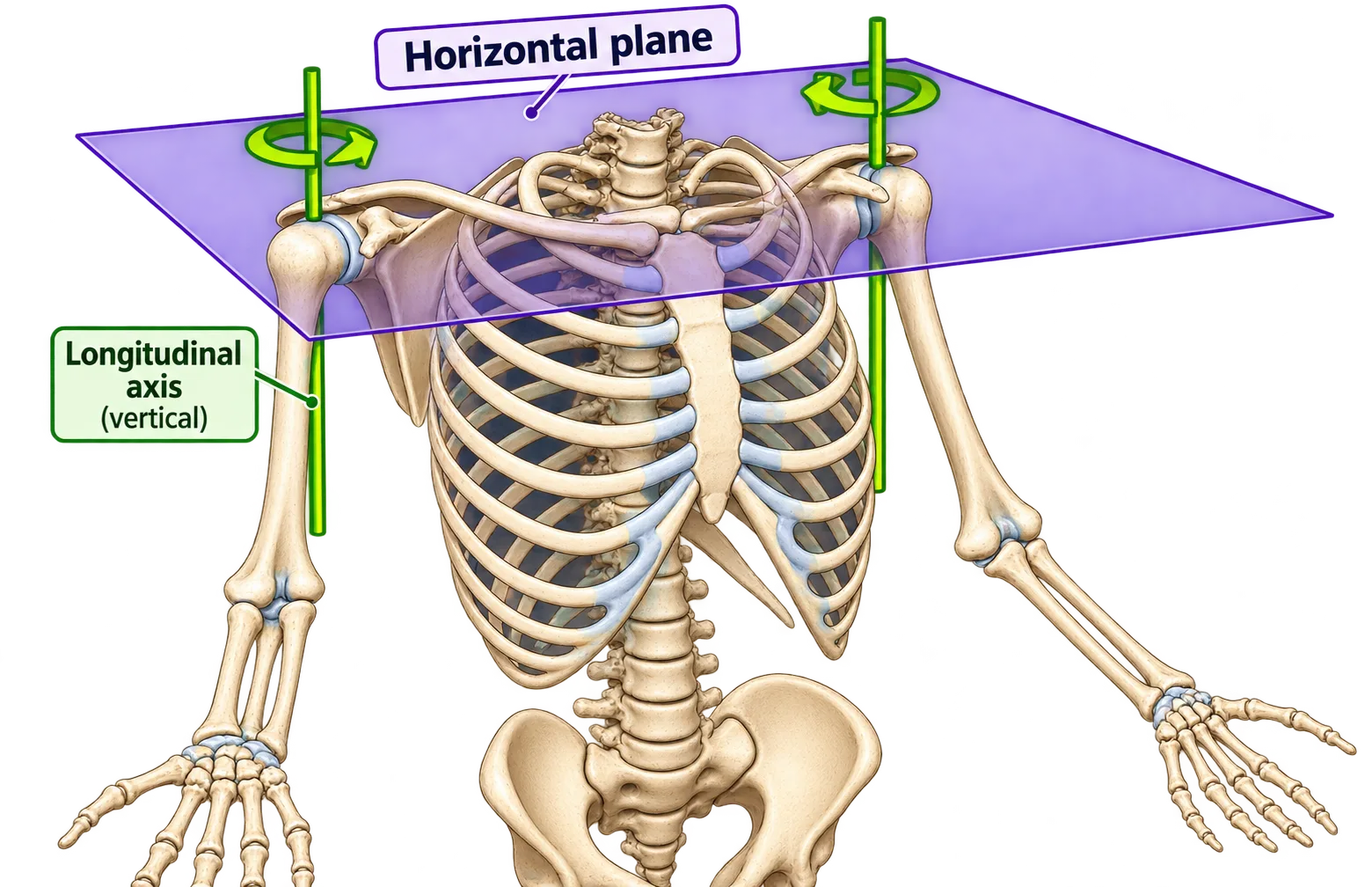
The transverse plane, also called the horizontal plane, runs parallel to the floor when the body is upright and divides it into superior and inferior portions, upper and lower. Transverse and horizontal are common synonyms, and some texts use transversal. As with the other planes, it does not need to split the body into equal halves.
Movements in the transverse plane are twisting or rotational movements. Typical examples are:
- rotation of the spine, head and neck;
- internal and external rotation of the shoulder and hip;
- pronation and supination of the forearm;
- horizontal abduction and adduction of the shoulder, with the arm held at shoulder height.
The perpendicular axis is the longitudinal axis, which is vertical when the body is in the upright reference position. A limb has its own longitudinal axis too, and when the limb is raised, its axis is not vertical in the room. Always say which coordinate system you are using.
The three axes and their other names
Every axis has more than one name in the literature, which is why students lose marks on terminology. The consistent pairing used throughout this article is:
- Mediolateral axis: runs left to right. Also called the frontal axis or transverse axis. It is perpendicular to the sagittal plane.
- Anteroposterior axis: runs front to back. Also called the sagittal axis. It is perpendicular to the frontal plane.
- Longitudinal axis: runs top to bottom. Also called the vertical or superoinferior axis. It is perpendicular to the transverse plane.
If an exam question uses a different label, work out the direction of the line, then decide which name it is using.
Plane, axis and movement at a glance
- Sagittal plane: divides the body into left and right portions. Axis: mediolateral. Typical movements: flexion and extension.
- Frontal (coronal) plane: divides the body into anterior and posterior portions. Axis: anteroposterior. Typical movements: abduction, adduction and lateral flexion.
- Transverse (horizontal) plane: divides the body into superior and inferior portions. Axis: longitudinal. Typical movements: axial rotation, and horizontal abduction and adduction.
Explore the planes
Pick a movement, then watch the plane and axis it uses. Orbit the view with your mouse or finger, or play the 40-second guided tour. The table and text beside the model say the same thing without it.
What are anatomical planes and axes?
A plane describes the surface in which a movement occurs; an axis is the line around which it rotates. In a single-plane model, the axis is perpendicular to the movement plane. Sagittal movements use a mediolateral axis, frontal movements an anteroposterior axis, and transverse movements a longitudinal axis.
Use this visual study aid from Munaza Physio Studio in Lahore, Pakistan, to compare the three planes. The same anatomical terminology applies worldwide and to every body.
Jump to the plane and axis comparison tableDemonstration, not normative range of motion
Rigged adult female model in a long black dress, covered sleeves and a red hijab. The dress stretches with the leg movement; fabric and joint motion are simplified. Axis arrows pass through the selected joint. The large sheets show body reference planes, not joint surfaces. Orbiting changes only your viewpoint.
- Plane
- Sagittal plane: divides the body into left and right portions.
- Perpendicular axis
- Mediolateral axis, running left to right. Also called the frontal or transverse axis.
- What moves
- The arm swings forwards (flexion) and backwards (extension) in the sagittal plane, about a mediolateral axis through the shoulder.
- What this simple picture leaves out
- The shoulder blade also moves, and a full overhead reach is not a single perfect plane.
The three planes and their axes
| Plane | Divides the body into | Perpendicular axis | Typical movements |
|---|---|---|---|
| Sagittal plane | Left and right portions | Mediolateral axis (left to right) | Shoulder flexion and extension; Elbow flexion and extension; Hip flexion and extension; Knee flexion and extension; Ankle dorsiflexion and plantarflexion |
| Frontal (coronal) plane | Anterior and posterior portions | Anteroposterior axis (front to back) | Shoulder abduction and adduction; Lateral flexion of the trunk |
| Transverse (horizontal) plane | Superior and inferior portions | Longitudinal axis (top to bottom) | Shoulder internal and external rotation; Trunk rotation |
The figure is schematic and the angles are demonstrations, not normative range of motion. Planes and axes apply equally to every body.
Check the definitions and movement examples in OpenStax Anatomy and Physiology 2e: Anatomical Terminology and Types of Body Movements. These demonstrations simplify real joints, whose axes can shift and whose movements often combine planes.
Joint examples
Shoulder and hip
The shoulder and hip are ball-and-socket joints. In the simplified model they have three rotational degrees of freedom, so movement can occur about all three axes. Shoulder flexion and extension are sagittal movements about a mediolateral axis. Shoulder abduction and adduction are frontal movements about an anteroposterior axis. Internal and external rotation are transverse movements about the longitudinal axis of the humerus. The hip works in the same way, with flexion and extension, abduction and adduction, and rotation.
Knee
The knee is best described as a modified hinge joint. Its predominant motion is flexion and extension in the sagittal plane about a mediolateral axis. It also allows real axial rotation, particularly when the knee is flexed. That rotation is part of normal knee function, and it is different from passive laxity or from motion that is coupled with another movement. So the knee is mainly sagittal, but it is not only sagittal.
Elbow and forearm
Elbow flexion and extension are sagittal movements about a mediolateral axis. Pronation and supination of the forearm are separate. They happen at the radioulnar joints, not at the elbow hinge, and they are rotations about the long axis of the forearm. Keep the two apart: bending the elbow and turning the palm are different movements at different joints.
Ankle and foot
Dorsiflexion and plantarflexion at the ankle are predominantly sagittal movements about a mediolateral axis.
Inversion and eversion are usually listed as frontal-plane movements, but this is a simplification. The foot has several joints with oblique axes, so these movements combine components in more than one plane. They should not be confused with pronation and supination of the foot, which describe composite movements.
Trunk
Spinal flexion and extension are sagittal. Lateral flexion is frontal. Spinal rotation is transverse. The range available differs by region, and most everyday trunk movements combine all three.
Circumduction and multiplanar movement
Circumduction, such as drawing a circle with the arm, is not a fourth plane and not a separate rotation. It is a sequence of flexion, abduction, extension and adduction performed in order.
More generally, real movement is multiplanar. Walking, running, squatting and sport involve several joints, each moving in more than one plane at once, along with small translations and axes that shift during the movement. One plane may dominate a particular joint action, but the whole task rarely stays inside it.
Female anatomical planes and axes: motion explainer
An 83-second silent explainer with captions. It shows each plane, its perpendicular axis and a movement in that plane.
Read the transcript
Female anatomical planes and axes. Munaza Physio Studio.
Anatomical position is the standard reference for describing the body.
The sagittal plane divides the body into left and right portions.
Sagittal plane · mediolateral axis. Flexion and extension.
The frontal plane divides the body into anterior and posterior portions.
Frontal plane · anteroposterior axis. Abduction and adduction.
From above, the transverse plane divides the body into upper and lower portions.
Transverse plane · longitudinal axis. Axial rotation.
All three planes and their axes, seen from three directions.
Real movement is multiplanar.
Each plane has one perpendicular axis in the simplified model.
Learn more at munazaphysio.studio
How physiotherapists use planes and axes
- Observation. A view approximately perpendicular to the plane of movement helps isolate that movement. A side view shows sagittal movements well; a front or back view shows frontal movements. Complex movements often need more than one view.
- Describing movement. Planes and axes let a clinician describe the same movement the same way as a colleague, in a report, or in a handover.
- Gait and posture. Clinicians commonly look at the sagittal plane for movements such as knee flexion, the frontal plane for pelvic and trunk lean, and the transverse plane for rotation.
- Exercise analysis. Describing an exercise by plane shows what it does and what it leaves out, which helps when planning a varied programme.
- Documentation. Consistent terms make notes clear, for example measuring and recording shoulder abduction rather than describing the arm going out to the side.
These are general uses of the vocabulary, not advice for any person. A physiotherapist decides what applies to an individual after assessment.
How to identify the plane and axis of a movement
Use four steps:
- Name the joint and the starting position.
- Describe what the moving segment does, such as swinging forwards, sideways or twisting.
- Decide which plane that movement sweeps through.
- Find the axis, the line through the joint at right angles to that plane.
Worked example: raising the arm out to the side.
- Joint: the shoulder (glenohumeral joint), starting with the arm by the side in anatomical position.
- Movement: the arm lifts sideways, away from the midline.
- Plane: the frontal plane, since the arm moves side to side.
- Axis: the anteroposterior axis, running front to back through the shoulder.
- Name: abduction.
- Limits: the shoulder blade and collarbone also move during a full lift, and a real lift is rarely in a single perfect plane, so this is a simplified description.
Common mistakes and exam traps
- Saying that all sagittal planes give equal halves. Only the midsagittal plane does.
- Treating frontal and coronal as different planes. They are the same.
- Mixing up the plane with the axis. The plane is the surface; the axis is the line perpendicular to it.
- Using "transverse axis" without checking what it means. Some texts use it for the mediolateral axis, and the transverse plane is a different thing.
- Treating the knee as a pure hinge, or saying it has no rotation.
- Calling circumduction a fourth plane.
- Confusing elbow flexion with forearm pronation and supination.
- Assuming every movement stays in one plane.
A memory aid
Think of three directions: side to side, front to back, and top to bottom. Every plane contains two of them, and its axis is the one it does not contain. The sagittal plane contains front-to-back and top-to-bottom, so its axis runs side to side. The frontal plane contains side-to-side and top-to-bottom, so its axis runs front to back. The transverse plane contains side-to-side and front-to-back, so its axis runs top to bottom. If you can say that for each plane, you have it.
Test yourself
Sixteen flashcards to study, then an eight-question quiz. Nothing you do here is stored or sent anywhere.
Read every card and question as plain text
Flashcards
- Name the three cardinal planes and what each divides.
- Sagittal: left and right portions. Frontal (coronal): anterior and posterior portions. Transverse (horizontal): superior and inferior portions.
- Name the three axes and their alternative names.
- Mediolateral (also called the frontal or transverse axis), anteroposterior (also called the sagittal axis) and longitudinal (also called the vertical or superoinferior axis).
- What is the difference between the midsagittal plane and a parasagittal plane?
- The midsagittal (median) plane passes through the midline and is the only sagittal plane that divides the body into equal left and right halves. Parasagittal planes are parallel to it, to either side.
- Are frontal and coronal different planes? What about transverse and horizontal?
- No. Frontal and coronal are synonyms, and transverse and horizontal are common synonyms (some texts say transversal).
- Why is the axis of rotation perpendicular to the plane of movement?
- In a simplified single-plane model, a segment swings within the plane, and the only line that stays fixed during that swing is at right angles to it, like a door hinge.
- Shoulder flexion and extension: which plane and which axis?
- The sagittal plane, about a mediolateral axis through the shoulder.
- Shoulder abduction and adduction: which plane and which axis?
- The frontal plane, about an anteroposterior axis through the shoulder.
- Shoulder internal and external rotation: which plane and which axis?
- The transverse plane, about the longitudinal axis of the humerus (the upper arm).
- How is the knee best described as a joint?
- As a modified hinge. Its predominant movement is flexion and extension in the sagittal plane, and it also allows real axial rotation, particularly when flexed.
- How is elbow flexion different from forearm pronation and supination?
- Elbow flexion and extension are sagittal movements at the elbow hinge. Pronation and supination are rotations of the forearm at the radioulnar joints.
- Ankle dorsiflexion: which plane and axis?
- Dorsiflexion and plantarflexion are predominantly sagittal movements about a mediolateral axis.
- What is the limit of calling inversion and eversion frontal-plane movements?
- It is a simplification. The foot has several joints with oblique axes, so these movements combine components in more than one plane. They are not the same as the composite movements called pronation and supination of the foot.
- Is circumduction a fourth plane of movement?
- No. It is a circular movement made by combining flexion, abduction, extension and adduction in sequence.
- What is the difference between osteokinematics and arthrokinematics?
- Osteokinematics describes how bones move, seen from outside the joint, in planes and axes. Arthrokinematics describes the small rolling, gliding and spinning movements between the joint surfaces.
- Why is walking described as multiplanar?
- Several joints move at once, each in more than one plane, with small translations and axes that shift. One plane may dominate a given joint action, but the whole task does not stay inside it.
- What is anatomical position?
- The standard upright reference position used to describe the body: standing, facing forward, arms by the sides, palms facing forward. Movement does not have to start from it.
Quiz questions
- Which plane divides the body into anterior and posterior portions?
- Sagittal plane
- Frontal (coronal) plane
- Transverse plane
- Midsagittal plane
- Which axis is perpendicular to the sagittal plane?
- Longitudinal axis
- Anteroposterior axis
- Mediolateral axis
- Oblique axis
- Which statement about the midsagittal plane is correct?
- It is the only sagittal plane that divides the body into equal left and right halves.
- It divides the body into upper and lower portions.
- It is another name for the frontal plane.
- It is the axis of flexion.
- In which plane, and about which axis, does elbow flexion occur?
- Frontal plane, anteroposterior axis
- Transverse plane, longitudinal axis
- Sagittal plane, mediolateral axis
- Sagittal plane, longitudinal axis
- Raising the arm out to the side is abduction. Which plane and axis describe it in the simple model?
- Frontal plane, anteroposterior axis
- Sagittal plane, mediolateral axis
- Transverse plane, longitudinal axis
- Frontal plane, longitudinal axis
- With the arm by the side and the elbow bent to 90 degrees, the forearm swings across the body and back. Which plane and axis?
- Sagittal plane, mediolateral axis
- Frontal plane, anteroposterior axis
- Transverse plane, longitudinal axis
- It cannot be described by a plane
- What kind of view best isolates a sagittal-plane movement?
- A view approximately perpendicular to the sagittal plane, which is a side view
- A view from directly above
- A view from the front
- Any view works equally well
- What is circumduction?
- A fourth plane of movement
- A sequence of movements, such as flexion, abduction, extension and adduction, performed in order
- Rotation about the mediolateral axis only
- A movement that occurs only at the knee
Frequently asked questions
The sagittal plane divides the body into left and right portions, the frontal (coronal) plane divides it into anterior and posterior portions, and the transverse (horizontal) plane divides it into superior and inferior portions.
A plane is an imaginary flat surface used to describe where a movement happens. An axis is an imaginary line that a bone rotates around.
Sagittal goes with the mediolateral axis, frontal with the anteroposterior axis, and transverse with the longitudinal axis.
Not quite. The median (midsagittal) plane is one particular sagittal plane, the one through the midline. Other sagittal planes are parasagittal.
They are common synonyms for the same plane. Some texts also use transversal.
In a simplified model, a segment swings within a plane, and the only line that stays fixed during that swing is at right angles to it, like a door hinge.
Yes. Many real movements combine planes, and the axes can shift during movement. Single-plane descriptions are simplifications.
No. Its main motion is sagittal flexion and extension, but it also allows axial rotation, especially when flexed.
They give clinicians a precise shared language for observing, describing, analysing and recording movement.
Key takeaways
- A plane is a surface; an axis is the line perpendicular to it.
- Sagittal: left and right, mediolateral axis, flexion and extension.
- Frontal (coronal): anterior and posterior, anteroposterior axis, abduction, adduction and lateral flexion.
- Transverse (horizontal): superior and inferior, longitudinal axis, rotation.
- Only the midsagittal plane gives equal halves.
- The knee is a modified hinge with real axial rotation, and circumduction is a sequence, not a fourth plane.
- Real movement is multiplanar, and every diagram here is a simplification.
Glossary
- Abduction / adduction: movement away from and towards the midline of the body.
- Anatomical position: the standard upright reference position used to describe the body.
- Arthrokinematics: the small gliding, rolling and spinning movements between joint surfaces.
- Axis of rotation: an imaginary line through a joint around which a segment rotates.
- Circumduction: a circular movement made by combining flexion, abduction, extension and adduction in sequence.
- Osteokinematics: the movement of bones as seen from outside the joint, described in planes and axes.
- Plane: an imaginary flat surface used to describe where a movement occurs.
References
Verify the current edition of each reference before relying on it.
- Standring S, editor. Gray's Anatomy: The Anatomical Basis of Clinical Practice. Elsevier.
- Neumann DA. Kinesiology of the Musculoskeletal System: Foundations for Rehabilitation. Elsevier.
- Kapandji AI. The Physiology of the Joints. Churchill Livingstone.
- Norkin CC, White DJ. Measurement of Joint Motion: A Guide to Goniometry. F.A. Davis.
- Wu G, et al. ISB recommendation on definitions of joint coordinate system of various joints for the reporting of human joint motion, Part I: ankle, hip, and spine. Journal of Biomechanics. 2002;35(4):543-548.
- Wu G, et al. ISB recommendation on definitions of joint coordinate systems of various joints for the reporting of human joint motion, Part II: shoulder, elbow, wrist and hand. Journal of Biomechanics. 2005;38(5):981-992.
This article is for education. It is not medical advice and does not replace assessment by a qualified physiotherapist. If you are in pain or have a movement problem, book an assessment or contact the studio.
Printable one-page reference
A single A4 sheet with the three planes, their axes and typical movements. Free to print for study.

Written by
Dr. Munaza Ghani
Munaza Physio Studio
Lead physiotherapist at Munaza Physio Studio in Allama Iqbal Town, Lahore, a private women-only practice for orthopaedic, women’s health and neurological rehabilitation.
- AHPC-registeredLicensed physiotherapist
- MSOMPT · DPTOrthopaedic manual therapy
- Women-only studioOne-to-one, private room
- Home and onlineAcross Lahore